
The Suite Spot & Social Mobility into the Exco by John Jeffcock
John Jeffcock, joined the IoD Surrey and Berkshire Quarterly Director Book Club dinner in September at Foxhills in Chertsey, and generously shared his experience of writing and highlights from his book.
Writing the Book
This was my third book, but my first business book. Prior to ‘The Suite Spot: Reaching, Leading and Delivering the C-Suite’, I had written two collections of war poetry, both generously supported by the Poet Laureate and the Ministry of Defence, with all proceeds donated to support injured soldiers.
When I began writing ‘The Suite Spot’, my process was visual and structured: I used a large A3 sheet divided into columns, each representing a chapter, filled with images, ideas, and learnings. Writing the book took more than a year and became an educational journey in itself. Research is fundamental to authorship, not only does it inform your work, but it also tests your assumptions, confirming some while disproving others. By the time a book reaches print, you have combed through it in detail at least five times, your own edits followed by rounds of proofing and editing by the publisher. As someone who is dyslexic, this discipline was both demanding and rewarding.
I first approached Ebury, who had published my previous book ‘Heroes: 100 Poems from the New Generation of War Poets’. They liked The Suite Spot, but felt it wasn’t the right fit for them. However, they generously introduced me to Bloomsbury. Around the same time, another publisher also offered to publish it, telling me it was the best synopsis they had ever read. What impressed them most was the market segmentation work I had included — not just identifying who would buy the book and why, but demonstrating my access to those audiences. Ultimately, publishers need to be confident about sales, and showing them how you can help deliver those sales makes them far more enthusiastic about taking your book on.
Social Mobility into the Executive Committee
You can work hard to rid an organisation of bias but if the people you are freeing from bias do not know how to climb the corporate ladder nothing will improve. At a personal level they will feel deflated and think nothing has changed.
This article is written to increase social mobility into the C-Suite and more specifically the Executive Committee (Exco). It offers new ways of thinking and challenges old assumptions, and gives the reader five big ideas to takeaway that they will wish they had known before.
The data used in this article is sourced from all public companies in North America, Europe and Asia. So it includes data from tens of thousands of companies
What is the Executive Committee ?
The Exco is the top leadership team in an organisation, is led by the CEO and is responsible for proposing and implementing the strategy. The average Exco has 9 people in Europe and just over 9 in the USA, with some sectors like financial tending to have more. In the FTSE 100 the average Exco looks like the below, with 5 Department leads and 3 Divisional CEOs.

The Digital Giants tend to have one more Department lead as they have both a CTO and a COO and one less divisional CEO. In the Digital Giants the CEOs are nearly 100% process orientated whereas in the FTSE 100 they are fairly evenly split between geography and process. For example, at HSBC (FTSE 100) they have a Regional CEO for the Middle East, North Africa and Türkiye whereas at Amazon (Digital Giant) they have a process CEO of Amazon Web Services.
Big Idea One – The CXO Method
The CXO method divides the role into its constituent parts – a Chief X Officer
- Chief – is about running the team, department or business unit
- X – is your area of expertise, whether that is legal, finance, tech, marketing etc
- Officer – is about adding value across the organisation and being a good company officer
The way your career works is it goes X -> C-> O. In your:
- 20s you learn your X (legal, marketing …)
- 30s you learn your C (start running teams …)
- 40s you learn your O (you need to deeply understand the business ,model …)
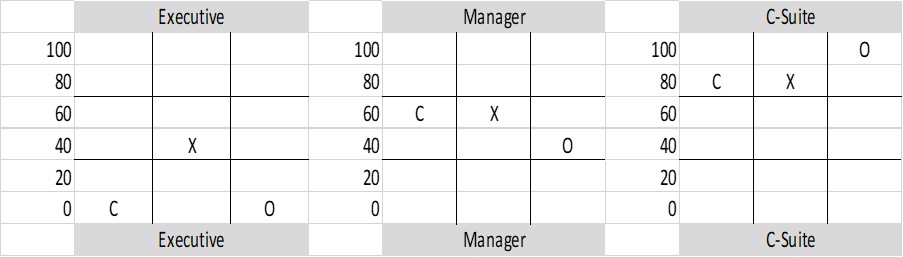
The average age of public company CEO in Europe is 56 and in Asia and the USA 58, and the Exco tend to be two to three years younger, which means you should be aiming to join the Exco in your late 40s. In the below diagram the importance of each C X O is ranked and you can see that each area continues to grow throughout a career, however, the weighting of most important shifts from X through C to O.
© Winmark 2024
So although your career may go X -> C-> O what gets you into the Exco is first O then C and then X. So the selection criteria for the top team is O -> C-> X the opposite to our career X -> C-> O.
Big Idea Two – The Chief Multidisciplinary Officer
Wikipedia lists 56 CXO corporate CXO titles and if you take CDO alone you can have a Chief Diversity, Data, Digital, Design and more. To be safe let’s assume 45 of these titles are sensible.
These 45 CXO roles all report to the same 5 Department leads in the Exco, so each has to have 8 different roles reporting into them. So nobody in the Exco is a specialist and instead they all need to be generalists or Chief Multidisciplinary Officers.
This means that McKinsey’s T shaped model of what an executive might look like. Where the vertical line is your technical skill and the top bar is internal communication or collaboration, may get you to just under the Exco but it fails to get you into it. In fact, the 45 ish roles are a bit like musical chairs and its important you have the ones that matter today and in the future under your remit.
The key is to recognise that in the Exco you will need to be a Chief Multidisciplinary Officer (CMDO) and beware of your peers doing land grabs for the most important areas.
Big Idea Three – The Shape of Departments Matters
We often ask business leaders how many people they have in their business or department but this is the wrong question to ask because departments have been changing shape and size.
Digitalisation has changed traditionally triangular shaped departments into diamonds, as the more administrative tasks were off shored. These administrative tasks and more are now being digitally on shored. I was recently talking with a CFO that had over 1,000 people in his Finance Department and he expects it to have only 106 people within three years. The opportunities AI Agents present may enable the Department to shrink by another 90% within 10 years.
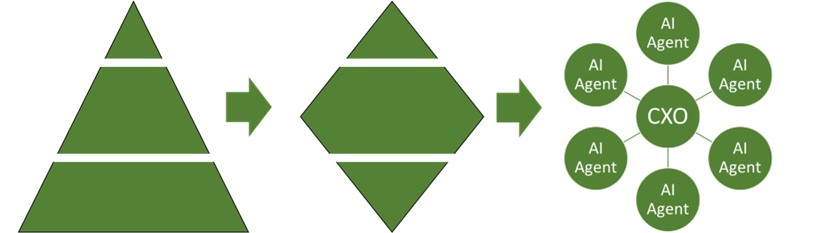
So when talking to Department leads we should stop asking how many people do you employ and start asking:
- Whether the Department is Centralisation or Decentralisation?
- How Process Mature is the Department?
- Is it better than the similar Departments in its competitors?
When you are choosing where to work, how the organisation and the departments are shaped and perform has a huge impact on the role. Some experienced Department leaders specialise and flourish in only certain shaped organisations.
Big Idea Four – Lateral Moves build Exco Points
90% of S&P 500 Group CEOs come from line, not staff roles, that means they are nearly always promoted divisional CEOs. So the theory that that the CEOs are all former CFOs, is not true. Only around 10% of CEOs were Department leads and the CFO takes around half of these.
This makes sense as the business units are materially larger than the support departments, therefore, the jump to group CEO is smaller, comes with less risk and is a closer skills set.
A good example of this is Steven. Steven was a retail banker at Barclays Bank, which employs over 80,000 people. He was offered £20,000 promotion but instead he had a difficult conversation with his partner and decided to work in the strategy function. He made a lateral move to gain central staff experience. He also realised that Barclays was a big international bank and he had no international experience, so he made another lateral leap and became a national lead. Steven has since been CEO of two banks.
Lateral moves between the operational business units and the support functions are important as they build breadth of knowledge and understanding that is important to have in the Exco. Lateral moves build Exco points.
Big Idea Five – The CXO Method applied to the CEO Role
Most business schools define the CEOs role as “the role of the CEO is to create, propose and implement the strategy.” What they often forget to say is “to achieve the purpose”. And this is really important because purpose always trumps strategy.
So for CEOs:
- The C is the C-Suite and to which they hold the keys
- The X is about executing the strategy, which is their fundamental role
- The O is about representing the organisation to stakeholders
If the current and future CEOs hold the keys to the Exco, you need to get on with them and their replacement if you want to be let in.
Conclusion
So the new career truths are:
- Purpose trumps Strategy
- In the Exco Breadth trumps depth of Knowledge
- Lateral moves build Exco points
- Line power trumps staff influence
- Different Department Shapes fit different people
- Your selected for the Exco based on your ‘O’ not your ‘X’
This is a guest article which contains views of the author and does not necessarily represent the views of the IoD.
About the author

John Jeffcock is a distinguished British business leader, author, and former military officer, currently Chief Executive of Winmark, the award-winning C-Suite network business. He leads 16 executive networks representing over 1,000 multinational companies across 18 countries.
A former Captain in the Coldstream Guards, John was decorated for distinguished service during the First Gulf War and later commanded the Northern Cordon around Sarajevo for the United Nations during the Bosnian conflict. In 2020, he published The Suite Spot with Bloomsbury, a widely acclaimed book on the C-Suite—described as “coolly analytical” by the BBC and “indispensable” by the CIPD. He has also authored and edited two volumes of war poetry, with proceeds supporting injured soldiers.
A strong advocate for social mobility, John is an Industrial Fellow and lectures on careers at Imperial College London, the University of East London, and Bayes Business School.
Contacting John Jeffcock
If you have questions or comments you would like to share about this article or my work and writing please reach out to me via my website or LinkedIn.


