

Zero in The business opportunity from net zero is huge. But firms must know the pitfalls.
It is the economic opportunity of the 21st century. The road to net zero is paved with green gold. But it is also cratered with hazards.
UK firms that approach net zero as an opportunity to be mastered stand to benefit on a grand scale. The agenda is estimated to be worth as much as £1 trillion to businesses by 2030. Yet, firms also report substantial barriers impeding their progress. The bumps in the highway to net zero will be significant. And the implications for local communities, as shown by a string of recent crises, are profound.
In the industrial heartlands of Port Talbot, Grangemouth and Scunthorpe, workforces face huge job losses as industrial decarbonisation accelerates. Ensuring areas such as these can prosper as the transition to a net-zero economy gathers pace is becoming an increasingly urgent economic development priority for policymakers. And it is one that sits at the heart of the government’s plans to foster growth.
Green lights
When Sir Keir Starmer entered 10 Downing Street last year as the UK’s new prime minister, he did so having made bold promises on clean energy. Ahead of the snap general election, Starmer regularly claimed that a Labour government would turn Britain into a “clean-energy superpower”. While in her shadow role, Rachel Reeves pledged to be “Britain’s first green chancellor”. The Labour leadership’s ‘big green ambition’ came in stark contrast to the Conservatives, who saw former PM Rishi Sunak announce green-policy rollbacks and attack “eco-zealots” in the run-up to polling day. For those firms with skin in the clean energy game, a new dawn – it seemed – had broken.
Fast-forward nearly a year, and an array of rule changes, reviews, policy papers, planning decisions and funding commitments have followed. The government remains committed to its manifesto commitments, even as others turn against the agenda. New US President Donald Trump promises to “drill, baby, drill”. In Britain, domestic political opposition to net zero is growing – Tory leader Kemi Badenoch recently shattering the long-standing consensus between the main political parties on the target. The mild-mannered former leader of the opposition, energy secretary Ed Miliband, has struck a pugilistic tone. “We are absolutely up for this fight,” he said in March.
Hard targets
So what, exactly, is he fighting for? Underpinning Starmer’s strategy are a series of ambitious targets – chief among them the legally binding target requiring the UK to bring all greenhouse gas emissions to net zero by 2050. This goal was signed into law in 2019 during Theresa May’s premiership through an amendment to the Climate Change Act 2008, a lodestar piece of legislation passed by the last Labour government which established a legally binding framework for the UK to reduce emissions. Scotland, meanwhile, is aiming to hit net zero five years earlier: it has a longstanding target to achieve net zero by 2045.
A suite of other targets should drive progress towards the overarching net zero goal. Labour’s core mission requires clean power to meet 100% of Britain’s electricity demand by 2030, although the small print of the target has some finer detail. In practice, it means at least 95% of electricity generation coming from low-carbon sources by the same date, with up to 5% coming from unabated gas – a strategic gas reserve to keep the lights on. It represents an advance on the previous Conservative administration’s commitment to “fully decarbonise” the power system by 2035.
To deliver on this mission, Labour says that it will work with the private sector to double onshore wind, treble solar and quadruple offshore wind by 2030. Miliband has already taken decisive action. He lifted the Tories’ de facto ban on onshore wind farms and approved three major solar farms with a combined generating capacity of 1.4 gigawatts in the earliest days of the new administration. Alongside this, the government has revised planning rules to speed up approvals of renewable projects, has signalled plans for grid expansion, and created a public energy system operator to accelerate progress. Fresh impetus came earlier this month, when the government published its much-anticipated industrial strategy, with “clean energy industries” having already been identified in a green paper as one of eight “growth-driving” sectors to be prioritised for support.
Big money
The changes are accompanied by some hefty public funding. That comes partly in the form of Great British Energy (GBE), Labour’s much-trumpeted state-owned energy company. Headquartered in Aberdeen, the body’s mission is to invest in the generation and supply of clean energy to accelerate the decarbonisation of the grid. It has more than £8 billion to invest in all four UK nations over the five-year parliament. Eye-watering sums will also be plunged into a separate National Wealth Fund (NWF), which is equipped with £7.3 billion of public investment intended to unlock £20 billion in private finance. These two entities will undertake different, but complementary, roles in the market. GBE will act as a developer; the NWF an investor and bank. Arrangements are still at a nascent stage, but ministers envisage that as well as leading projects itself, GBE will co-develop schemes with private sector partners through joint ventures or equity stakes.
Labour’s wholehearted support for the net zero agenda may represent a ratcheting up of ambition, but the clean energy sector was already growing rapidly before Starmer arrived in Downing Street. Its growth presents a transformative opportunity for regions across the UK. Regions poised to become hubs of sustainable economic activity, according to a study by CBI Economics for the Energy & Climate Intelligence Unit (ECIU), include the West Midlands and North West, which are using their strong industrial bases and manufacturing expertise to develop and deploy green technologies. Coastal areas, meanwhile, particularly aside the North Sea, are ideally placed to tap into the opportunities presented by offshore wind farms. Local strengths such as these create hotspots of net zero activity, driving regional economic growth, the ECIU says. The net zero economy is particularly important to Scotland. Since 2022, it has grown by 21.3% north of the border, according to the report.
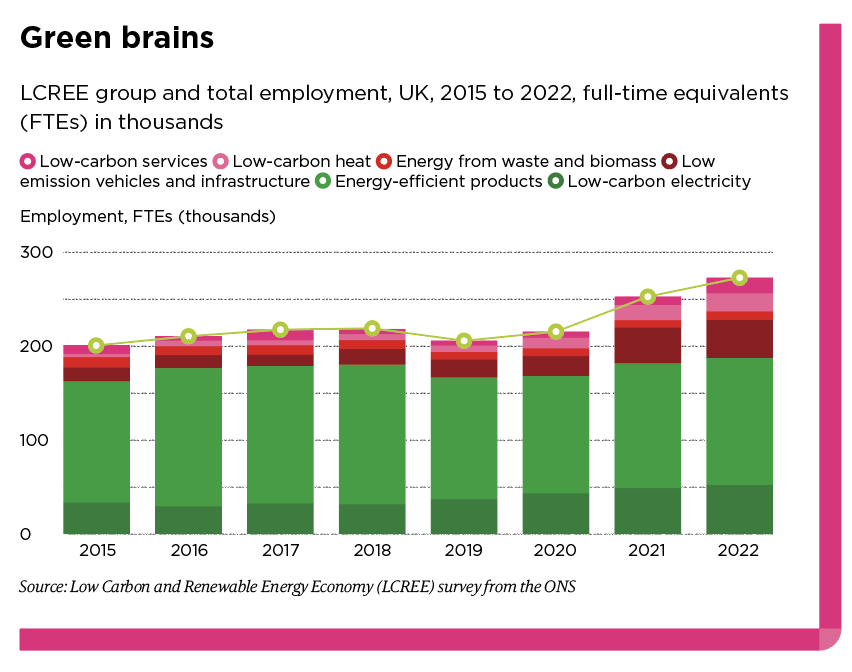
Yet even UK-wide, the net zero economy is a “significant driver of growth and innovation” and has achieved “remarkable growth over recent years”, says the report. The sector grew 10.1% between 2023 and 2024, and now generates £83.1 billion in gross value added. Using a different methodology, the Office for National Statistics estimates that the turnover of the UK’s low-carbon and renewable energy economy – a group of 17 subsectors – has grown from £43.7 billion in 2014 to £54.4 billion in 2021.
Growing rich
Whatever the yardstick, this thunderous growth will likely continue. It presents huge opportunities for businesses of all shapes and sizes, spanning the length and breadth of the country. A 2021 analysis by consultancy McKinsey found that supplying the goods and services to enable the global net zero transition could be worth
£1 trillion to UK firms by 2030.
These opportunities come in many forms, in many locations, and can be exploited by many types of business. “For business, acting on net zero means more than an exercise of ESG compliance – this is fundamentally about commercial competitiveness and positioning companies to seize the benefits that the transition will bring,” a 2023 report by the Advisory Business Group for the UK’s Climate Change Committee said.
One key opportunity for businesses is to reduce costs by curbing their own emissions. Emissions tend to be associated with generating heat – and generating heat is inefficient. Firms can reduce their overheads and improve their profit margins by reducing these inefficiencies. “The direct causal relationship between lowering your overall emissions and becoming a more productive firm creates a compelling business case,” noted Alasdair Grainger, net zero managing director for consultants Grant Thornton, in an October 2024 briefing.
Sadly, not every firm will capture such benefits. They will vary according to sector and company size. According to McKinsey, only around a quarter to a third of potential climate change mitigation investments made by businesses between 2021 and 2030 are likely to have a positive business case without subsidies. And a census of more than 2,000 firms by UK Business Climate Hub, found larger firms more likely to expect cost savings from
the transition.
Revolutionary returns
Yet the net zero economy promises more than efficiency savings. There is a giant opportunity for firms to provide goods and services to support what McKinsey calls the “green capex revolution”. While most of the demand for net zero-related goods and services is likely to emerge outside of the UK and EU, the firm points out that some sectors in the UK are well placed to benefit. These sectors are those where the UK already has a competitive advantage, such as exports of financial services; professional, scientific and technical services; information and communication services; pharmaceuticals; and aerospace equipment.
These industries are also prime providers of inputs into net zero capital projects, such as building offshore wind farms, reinforcing grid infrastructure, designing more carbon-efficient buildings, or greening transport systems, according to McKinsey. Further benefits to business from the net zero drive can include an enhancement of organisational reputation, securing a competitive advantage and improving access to finance. A 2024 Grant Thornton survey found that 81% of lenders said a firm’s ESG status or ability to transition to net zero will have an “increasing influence on their appetite to lend” over the next five years. Firms that fail to act risk a credit crunch.
Preparation pitfalls
Exploiting net zero opportunities will not be straightforward. There are several potential pitfalls for businesses that fail to prepare for the shift. Many companies already report significant barriers, such as outdated infrastructure, regulatory uncertainty and a lack of trusted information sources. “Organisations recognise net zero as essential, but high costs, policy uncertainty and skills gaps are leaving many unsure about the path ahead,” a report from the UK Business Climate Hub found.
Those skills gaps can be large – and hard to fill. Shifting to new processes will require companies to make new hires or upskill their existing workforce. But such skills come at a premium – and, even if firms can afford them, applicable skills remain scarce. Although many workers in carbon-intensive industries have skills that can transfer to the clean energy sector, clean energy industries are still likely to face “acute” skills challenges, the government’s Office for Clean Energy Jobs reported in March. It predicts increasing demand in the clean energy jobs market across a range of roles – and warns that competing sectors will seek similarly qualified workers.
Starmer’s administration has made several business-friendly pledges in its green gold rush. Unlike other sectors, which face gruelling public spending cuts, the investment in energy is real, and it is lavish. Companies that are ready for the switch will gain. Yet to avoid the pitfalls on the road to net zero – and to capitalise on the opportunities the clean energy transition presents – business leaders must take steps to ensure they stay on course. They will likely need a firmer hand on the wheel from a government that has – so far – been better at creating the opportunities than helping businesses deliver on them.
About the author

Jamie Carpenter is the multiple award-winning editor of ENDS Report, the UK’s leading publication of environmental professionals. Carpenter set out on his career in journalism with the aspiration of writing about something glamorous, like film, but ended up spending much of the 20 years covering sewage and toxic chemicals, developing encyclopaedic knowledge of the threat posed to humanity by everyday household objects.

Director Magazine
This article is published as part of IoD Director, the authoritative voice of UK business leadership.

Get updates from Director
There has been an unexpected error.
Thank you for subscribing.
Unsubscribe at any time. Read our privacy policy.


