

The entrepreneurial metropolis If Britain’s cities are to get better, they must get bigger
In Cllr Steve Battlemuch’s Wollaton West ward, you can travel without moving. His ward abuts a place called Broxtowe, a territory in the western suburbs of Nottingham over which neither Battlemuch, nor any of his fellow councillors on the city’s council, have jurisdiction.
The border with Broxtowe is hidden in plain sight. It trickles along a tiny brook that flows at the bottom of residential gardens, before cutting through the brickwork of several suburban houses, then running along the middle of a street. Without the help of an Ordnance Survey map, or an esoteric knowledge of wheelie-bin branding, you would be unaware of the absurdities. But the anomalies are far from unique and – to those that want Britain’s cities to reach their potential – the freakish borderlines represent a barrier to economic growth. “The city has suffered from its ridiculous boundaries since before most people here were born,” says Battlemuch. “Strategic planning is near impossible – the four boroughs that cover the city area bicker over investment and funding – and trying to get anything built can take years.”
Battlemuch is a lifelong Nottingham Forest supporter and season-ticket holder. The club’s city rivals Notts County are sited in city territory. Yet Forest’s confusingly named City Ground sits on land owned by the city council, but under the political jurisdiction of two rival local authorities, across the murky waters of the Trent. It is a city riven by a river.
Little wonder, then, that Forest’s plans to expand their stadium have been bogged down in years of inter-civic conflict. “If a city-wide structure had been in place, the expansion would have been much simpler – as Forest would have been dealing with one council, not three,” says Battlemuch. “Years of potentially attracting an extra 10,000-15,000 people to the city every other weekend – eating, drinking and staying in Nottingham – have been lost to a bureaucratic nonsense.”
Peer pressure
Nottingham is the worst-performing of all the major cities in the UK, in terms of gross value added (see graphic). Yet all Britain’s large regional cities compare dismally to London, and to most of their European peers. “Manchester and Birmingham have particularly low productivity for their population size,” an expert team from Harvard Kennedy School – which included former shadow chancellor Ed Balls – reports. “As a result, cities outside the South East contribute less to the economy than we would otherwise expect.”
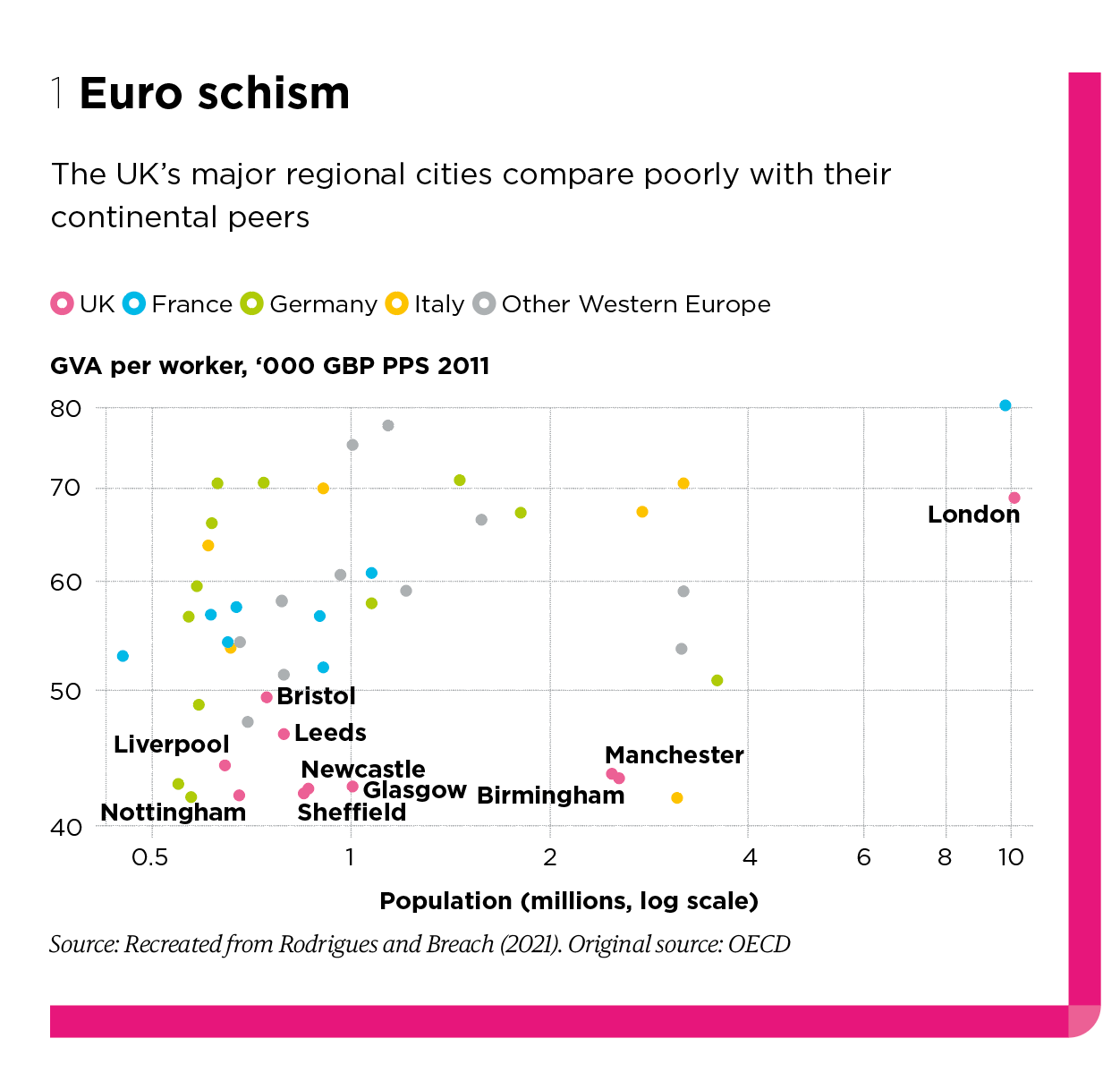
But the devolution and decentralisation of powers over strategic functions such as transport, economic development and skills – which are more common in continental Europe – could offer a tonic. Spending decentralisation is associated with fewer geographic economic inequalities and improved regional productivity, the Harvard report says: “The UK is one of the most centralised advanced democracies in the world – and there is … evidence for this acting as a constraint on growth.”
Fortunately, there might be change afoot. In its devolution white paper, Angela Rayner’s Ministry of Housing, Communities and Local Government (MHCLG) has pledged to abolish two-tier councils and rationalise England’s local authorities into single-tier units of more than 500,000 residents. Nottingham could benefit from the reorganisation. Bristol, and other cities that are hemmed in by constricting borders, are eyeing similar changes. But what economic development and business benefits would widespread reorganisation bring?
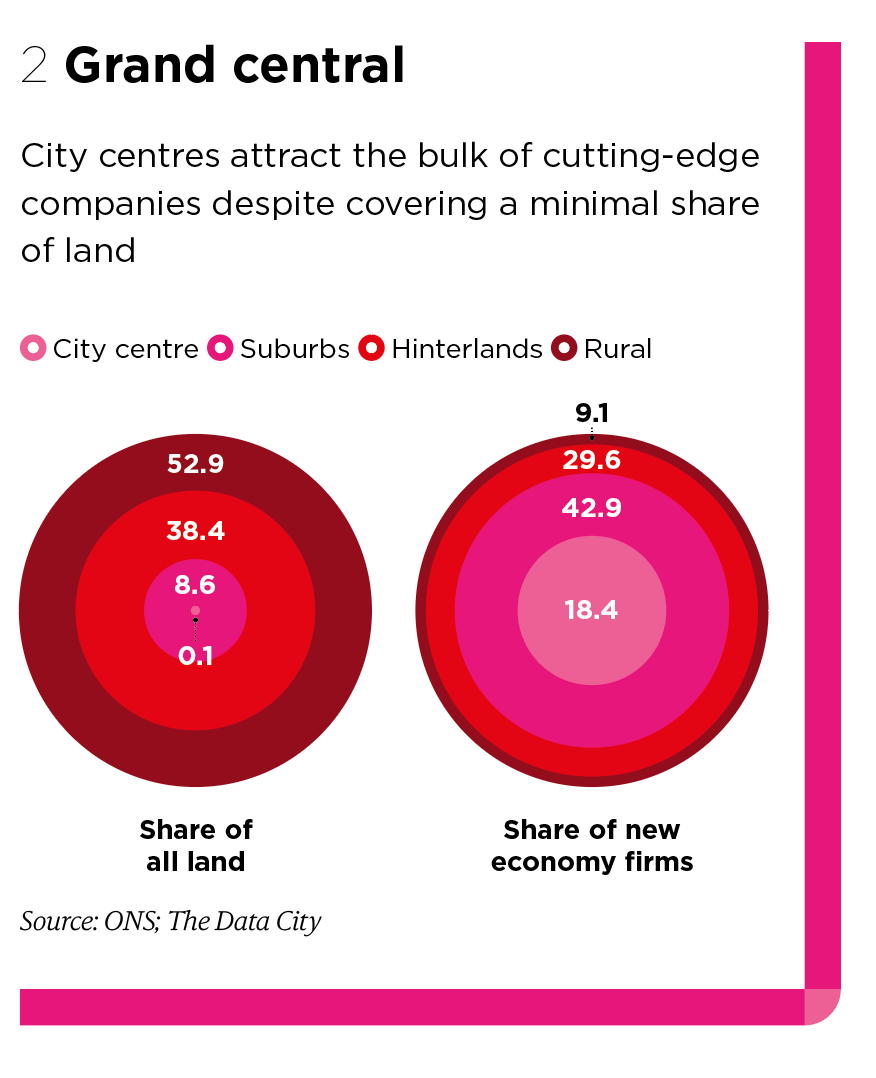
The Centre for Cities is a think-tank that has studied the performance of the UK’s urban areas for two decades. Its key finding is that thriving city centres are crucial to economic growth: they act as a magnet for high-tech, cutting-edge firms, and help boost the economic performance of the city-regions they serve (see graphic).
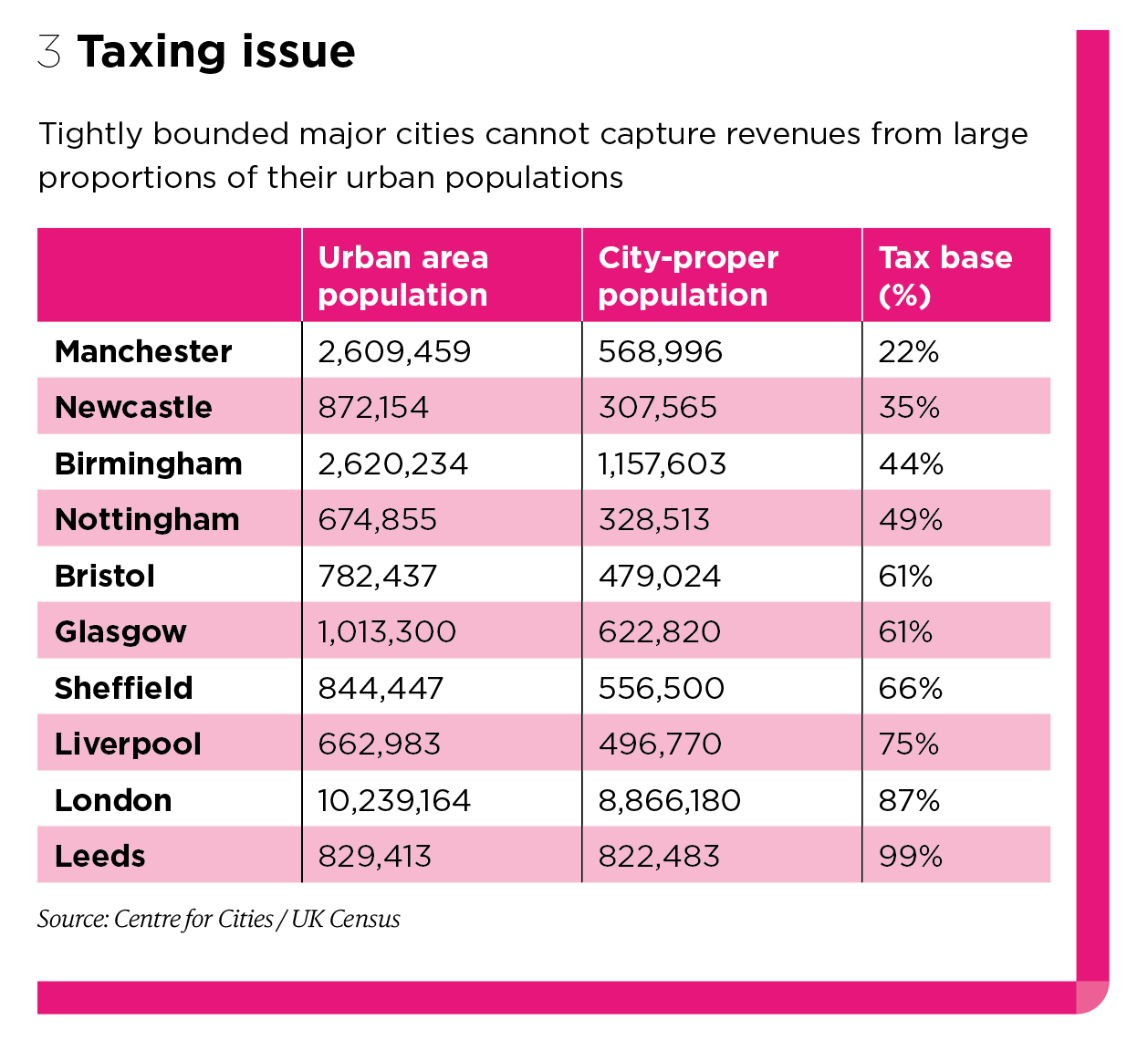
Yet, developing and maintaining thriving city centres is a costly pursuit. Thus, tax base matters: constricted cities such as Nottingham and Newcastle cannot capture the revenue from most of the population that relies on their city centre (see graphic). “We are responsible for delivering the services expected in a core city,” Nottingham’s council leader Cllr Neghat Khan tells reporters. “But many of the people who work in the city – and use council services – live in the suburbs, meaning they can’t vote in city elections, and pay council tax elsewhere. We need to address
that imbalance.”
Size matters
Much of the problem lies in the fact that inner-city areas tend to be poorer than their suburbs, which often lie outside the city limits. Around 80% of properties in Nottingham city-proper are in the two lowest council-tax bands. A few yards over the Trent, in Rushcliffe, that figure is only 30%. A similar phenomenon exists in other major cities around the UK.
Ed Balls’ work at Harvard has shaped his view that the scope, size and scale of cities matters. “It’s right to want to devolve more power over planning and transport and skills to proper functioning city-regions,” Balls tells Director via his Political Currency podcast, which he co-hosts with his erstwhile opponent, former chancellor George Osborne. Balls laments the loss of the old metropolitan councils, which were upper-tier authorities with powers over entire urban areas, like Greater Manchester and Merseyside. “[What was] put to us by Michael Heseltine was that the big mistake was to move away from the big metropolitan councils, and that, if you were really being radical, what you ought to do is have one council and one leader for a West Yorkshire or a Greater Manchester metropolitan authority,” he says. “That isn’t the direction that … government has taken [so far]. Instead, you have a mayor who looks across that whole expanded city-region, but you keep the component local authorities and require them to work together. Would it have been more radical and more effective to move [back] to those big city-region authorities? I’m not sure I would have abolished them in the first place.”
Radical action
For his part, Osborne introduced a raft of city-regional mayoralties while chancellor in 2016. Metro mayors, such as Andy Burnham in Greater Manchester, go some way to addressing the bureaucratic, anti-growth mess that had hampered many fragmented urban areas in the past. The model was a way of circumnavigating parochialism and addressing the issue without triggering a likely disruptive round of local government mergers. “People can get very anxious about being included in cities when they think they’re not,” Osborne responds to Director on his podcast. “When I was an MP, [some] people in Stockport still wrote Cheshire on their post. They didn’t want to say they were in Manchester, they wanted to say they were in leafy Cheshire. Generally, with local government reorganisation, I always thought it was better to use lots of carrots rather than sticks.”
Yet the Centre for Cities (CfC) is urging exactly the radicalism – and the sticks – to which Balls and Osborne allude. In its 2025 Cities Outlook report, it warns that only the firm hand of central government will effect the necessary changes in the face of often vocal opposition from some local councillors and residents. “The opportunity is to put the structures in place – through local government reform – to create a system that enables deeper devolution,” the report says. “This will be important to give UK cities the same freedoms afforded to international comparators … The challenge is that reform will be contentious, requiring the government to take unpopular decisions on the merging of local authorities so that they better reflect the areas in which people live and work. As the only institution that is able to determine how the whole system needs to work, it should be proactive in setting out what areas these new structures should cover.”
Paul Swinney, director of policy and research at CfC, fears that government lacks the courage to follow through on that crucial pro-growth package. “The government set out with a fairly clear idea of what it wanted to do,” he says. “Devolution was part of its growth agenda, and therefore it was going to reorganise local government to reflect the way that people live their everyday lives in terms of where they live and work. But once they got to the white paper, that’s become confused. Economic geography is [now just] one of several – sometimes conflicting – criteria. The discussions we’ve been party to with civil servants suggests that the clarity [Labour] had when they first came to power seems to have waned.”
In recent times, there has been an unwelcome tendency to ‘fill in the map’ – to create combined mayoral authorities everywhere, whether the economic geographies make sense or not. Nottinghamshire is in a mayoralty with Derbyshire that stretches from the Lincolnshire border to the 2,087ft summit of the Peak District. When hikers reach the top of Kinder Scout, it is Manchester they see, not Nottingham. “The western half of High Peak points into Greater Manchester,” says Swinney. “It means they’ve got a mayor who has been given an almost impossible job in terms of how to set up the infrastructure. The area is enormous.” The supersizing risks being repeated nationwide, adds Swinney (see box).
This government would not be the first to be knocked off course. Several administrations have attempted to solve the seemingly intractable problem of outdated, incongruous and restrictive urban boundaries – then retreated, or fudged, in the face of virulent opposition from vested interests. “In 1968, [Baron] Redcliffe-Maud’s report looked at the 1,300 local authorities that had been created when the only means of travel was by foot or horse,” Lord Heseltine said in 2022. “He recommended their replacement by 62 unitary authorities. It was the right judgement – except in the eyes of all those with a stake in the status quo.”
Yet perhaps Rayner, arguably the most dynamic government minister, will advance where others have flopped. “Very few people have got a grasp of this,” says Swinney. “The whole point of devolution is that we’ve currently got a model where all power sits in Whitehall, and it’s almost impossible for a civil servant to have all the information in one place, to be able to craft good policy for place X, then do the same for place Y and place Z. Through devolution, you are meant to be passing those powers down to an appropriate geography, so the people who have got all that information – because they work there – are able to then make policy about that area. They can tackle the challenges they face – and shape it towards the opportunities they have.”
Back in Nottingham, the aptly named Battlemuch will fight on, even if it means he will lose his seat in a reorganised authority. “It’s a once-in-a-lifetime opportunity to finally sort out the city,” he says. “We need a big authority that covers the whole urban area, so we can plan development and grow our economy.” Whitehall is due to finalise plans this autumn. “We want local leaders to take back control and make deeper devolution across the country the default,” MHCLG says.
For now, Battlemuch must wait. The legendary manager of his beloved Forest, Brian Clough, once said: “The Trent is lovely, I know because I have walked on it for 18 years.” Maybe, someday soon, the river might link the city together, rather than saw it apart.
Minnows to monsters
Fear of missing out is luring areas into creating sprawling combined authorities that fail to reflect economic geography, think-tank the Centre for Cities warns. “[The attitude seems to be] ‘Greater Manchester’s got loads of people so we need to be really big as well’ – which is different to thinking about what area the economy operates over,” says its policy director Paul Swinney. “It’s the opposite problem to that of cities like Nottingham.” He cites the proposed Heart of Wessex mayoralty as an example of the misstep. The proposed body stretches almost 100 miles, from Bournemouth to the Somerset border with Devon. “It is enormous,” he says. “It doesn’t make any sense.” Director understands that the Ministry of Housing, Communities and Local Government is encouraging combined authorities with populations exceeding 1.5m.
About the author

Ben Walker is editor of Director magazine.

Director Magazine
This article is published as part of IoD Director, the authoritative voice of UK business leadership.

Get updates from Director
There has been an unexpected error.
Thank you for subscribing.
Unsubscribe at any time. Read our privacy policy.


