

The clashing cults of WFH and RTO Rival three-letter factions are waging a corporate Cold War. Is a truce possible?
Two tribes go to war. Some companies credit remote working as the silver bullet that’s catapulted them into rapid growth. Employees can work around the clock, all over the world, energised by a morning run instead of listless from standing on a packed train. Others believe physical distance between leaders, teams and colleagues is a recipe for disaster. The lack of proximity causes a decline in engagement, collaboration and productivity – justifying a return to office (RTO) mandate.
There’s data that supports both stances. In a recent Culture Amp survey of 241,605 employees across North America, EMEA and APAC, remote workers were more likely to feel their companies had a collaborative and communicative culture than their in-office counterparts, and were more likely to feel engaged. The same study, however, found that fully in-office workers were more inclined to feel they had the systems and processes in place to work effectively, that the information they needed to do their jobs was readily available, and they knew how to be successful in their role, compared with those working fully remotely.
So which tribe is the strongest – WFH or RTO, and whose voice the loudest? The 20,000 employees of advertising group WPP that signed a petition opposing the instruction to its 114,000 global staff to attend the office four days a week? Or the giants leading the RTO charge – the likes of Amazon, Apple, Google, Tesco and McKinsey?
Hire from anywhere
One undeniable benefit of remote work is the ability to recruit talent from anywhere. It’s something payroll and HR platform Deel credits for its fast growth, and the “world class” productivity it boasts from 4,500 employees across 104 countries, according to Matt Monette, the company’s UK and Ireland lead, and head of expansion for MENA and Israel. Deel was founded in 2019 as a remote company. It remained so post-pandemic.
“If we have a problem that we’re solving in the UK, let’s say we’re not able to solve it by the end of the day, well, it can actually get resolved overnight,” says Monette, speaking to Director from Dubai, where he is currently recruiting. He is usually based just outside Bath, and travels to London occasionally for client meetings, when he works from a WeWork hub.
“And we provide a better quality of life for individuals,” Monette adds. “We see that massively internally – having people who are actually happy because they don’t need to get into a Tube and commute an hour and a half. They can wake up, have a coffee, take their kids to school, take their dogs for a walk, just spend time recharging and delivering their best self.”
Being tied to offices would hamper the company’s ability to recruit the best – and reduce the company’s diversity, Monette adds. Under the firm’s remote model, talent can come from all over the UK, rather than just London. Companies rejecting remote work, he argues, are doing so because of inadequate investments in the right technology to enable collaborative work, and – because of poor leadership and a lack of clear mission – they feel the need to ‘babysit’ their staff.
Rather than feel pressure to reconsider the way the company is structured as more companies announce RTO, Monette says it validates its remote stance – especially as it sees a “massive influx” of candidate interest every time it happens.
It happens, too, to software company Iplicit, whose 160 employees mainly work fully remotely. It dabbled in offices after launching in 2019, but flourished under the remote-work conditions of Covid. It now just has a small office in Poole, Dorset, for engineers and developers.
“Our competitors that are announcing a return to the office are longstanding, three-decade-old incumbents that are massive, so they’ve got an outdated business model and an outdated approach to market,” says Iplicit chief executive Lyndon Stickley, who is based in London. “We love it because we’re getting recruits that call us and say, ‘I’ve been working well at home. I’ve been hitting my targets. Now I’m told I have to go in three days a week minimum.’
“We’re getting an inflow of recruits that are talented and capable, and can work ten hours a day from home, while still being on the school run, and walking the dog, and putting their kids to bed. So it’s a brilliant scenario for us.”
Proud to be office-first
Alan Price has felt some of those losses as chief executive of Manchester-based BrightHR, an HR management platform with 250 UK employees, since returning fully to the office in 2022. The firm’s RTO shift impacted those staff who had moved away having been able to work remotely. Yet due to the high-tech and connectivity requirements of running, developing and selling the platform, Price is clear that BrightHR is an office-first company. Perks include a gym, coffee machines and views across Manchester.
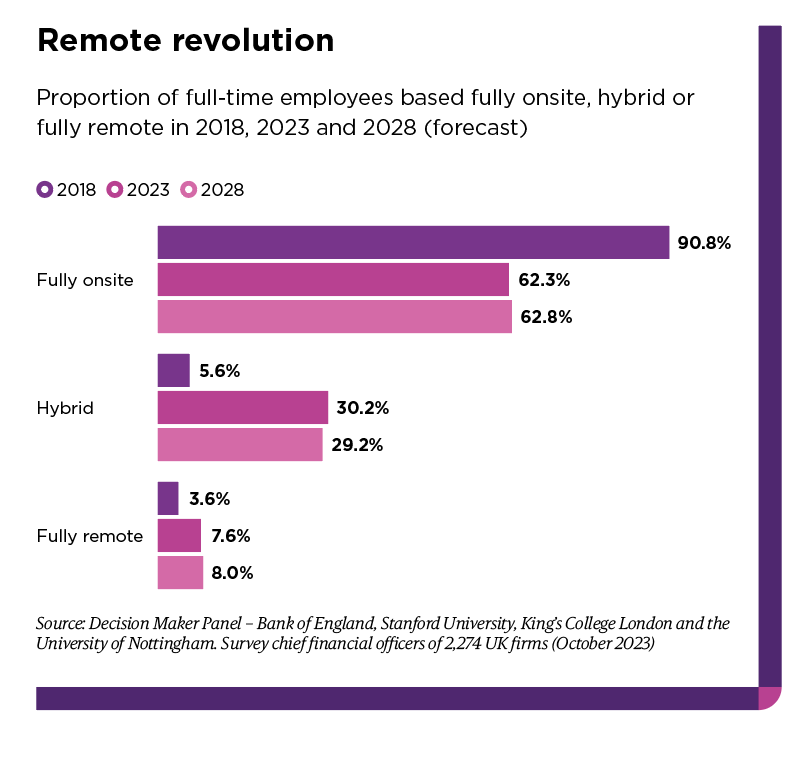
“With employment law and HR policies changing on a daily basis, you need the team all around the table on the same day,” says Price, who commutes 90 minutes each way, every day from Derby. “With the best will in the world, it’s difficult to get five marketers on a Teams call quickly. I think it’s going to be a number of years before individuals understand that they’re missing out on the collaboration and rapport building with their colleagues when they work remotely. A lot of people’s relationships will be pre-Covid, and there will be new people now in the workplace with different life skills and backgrounds that you’re just not going to see on a Teams call, because [those calls are] very transactional.”
In the same way Iplicit and Deel attribute their success to remote work, Ben Chaplin, managing director of tax and accounting specialists Croner-i, counters that remote-working is a productivity blocker – a view, he says, which is proven by Covid’s affect on his business. Like Price, Chaplin is convinced that remote-working is losing its allure, and companies will eventually re-adopt the office.
“We’re an innovative, high-growth business, that is very client- and solution-focused – that goes hand-in-hand with us all being together in the office,” says Chaplin, who divides his time between the company’s Leicester and London offices. “Remote has been running out of steam for some time. A lot of businesses thought they could get away with reducing their office space by letting people work at home, but where’s your future going to be?”
Both Price and Chaplin say that the clarity of their in-office policy means they receive few remote-work requests, but can accommodate some flexible hours where necessary. Legally, under the Employment Relations (Flexible Working) Act 2023, employees now have a right
to request flexible-working from their first day on the job. Employers must respond within two months.
While it doesn’t mean flexible working itself is an employee right, an employer that doesn’t allow remote-working could be open to challenge under the Equality Act, warns Nicola Welchman, partner at Bloomsbury Square Employment Law.
“Someone who has a protected characteristic under the Equality Act could pursue a tribunal claim for discriminatory conduct,” she says. “Applying a blanket policy which doesn’t look at individual circumstances is where an employer may run into difficulties.”
To be young
Yet perhaps where in-office companies like Croner-i and BrightHR are set to reap the biggest rewards of being fully office based is their ability to recruit graduate talent. Croner-i hires 25 graduates each year. The graduates are offered in-person mentoring and development. This wouldn’t be feasible with remote working, says Chaplin. Remote companies that fail to develop young talent could cause wider skills issues across the country in the near future, he warns.
Iplicit’s Stickley is aware of this. “There’s £43 million behind this venture,” he says. “When you want to go unbelievably fast, you’ve got no time for trainees or younger, inexperienced people. But we cannot afford to not bring in graduate talent when we want to get really big. In three or four years, when we get to about 300 staff, we’ll then start to build graduate programmes, to take advantage of fresh thinking and new blood, so we’ll start to have hubs, and move to a hybrid model.”
The need for younger team members to be exposed to their peers in the office is where Stickley and Chaplin see eye to eye. “How can you leave all your experienced people at home, when graduates need [to learn by] osmosis?” concedes Stickley. “You’ve got to get your good people back so that the osmosis can happen.”

Director Magazine
This article is published as part of IoD Director, the authoritative voice of UK business leadership.

Get updates from Director
There has been an unexpected error.
Thank you for subscribing.
Unsubscribe at any time. Read our privacy policy.


