

Hive minds Collective intelligence is worth the work
We all know how this story ends. In 1975, an engineer at Kodak invented the digital camera. When he demonstrated it to his management team, they dismissed it, downplaying the innovation to protect the company’s hugely lucrative photographic film revenues. Over the next three decades, engineers continued to develop digital photography technology, but successive boards and leadership teams refused to commit to embracing it as a strategy. By the time Kodak seriously started moving into digital, it was too late. In 2012, the firm filed for bankruptcy.
Kodak’s failure to innovate isn’t a story of individual stupidity or culpability – the firm was full of brilliant people. Rather, it’s a fable of collective institutional blindness: a board acting as less than the sum of its parts. And it is not an isolated example of a board failing to live up to its promise.
“Until you go into a boardroom, you assume it’s a well-oiled machine of the most powerful and experienced people wrestling with thorny issues through high-quality debate and discussion, but the reality is very different,” says Megan Pantelides, senior director at Board Intelligence. The many examples of “boards failing in their duties, scandals and bust-ups” (Carillion, the Post Office and BHS are just a few examples) hammer the point home.
And while recruitment is important, it is only half the battle. The bigger challenge comes when people are already seated around the table, creating and harnessing the collective intelligence – the hive mind – that enables the board to operate as far more than the sum of its parts.
“Collective intelligence is when you pool the intellectual capital of a group of people, tapping into each individual’s unique experience, perspectives and knowledge to deliver better outcomes,” explains Pantelides. “It’s about giving individuals a platform to add value through their expertise and viewpoints, but it’s also about the group, coming to the right conclusion, making the smart decision and doing it quickly. It’s two plus two equals five.”
But building collective intelligence is easier said than done, with directors facing a series of challenges, many of them structural. First, there’s the simple yet inescapable fact that boards meet infrequently. This, says Dr Philip Stiles, associate professor of corporate governance at Cambridge Judge Business School, stands in the way of boards learning to come together and perform as a team. “Teams are groups,” he points out. “And groups need time to develop.” He adds that the natural split between executive and non-executive directors can also stymie the development of collective intelligence.
The same is true of time constraints in the meetings themselves, as well as in how agendas are designed, says Pantelides. “The first thing on the agenda is approving the minutes from the last meeting, then listening to a series of performance updates… Time for strategic discussion is often curtailed, and the mental energy in the room has dissipated by that point.” This is a major miss given that collective intelligence brings the most value when it is used to shape strategy rather than monitor performance.
Away from the structures of the board, there’s the challenge of effectively managing the personalities of those involved. That must start with selection, which should be viewed through the lens of creating the ideal conditions for collective intelligence to flourish. Randall Peterson is professor of organisational behaviour at London Business School and an expert in board dynamics. In his time observing boardroom behaviour, he sees one theory regularly proven wrong: “Assuming that getting the ten smartest people together in a room will give you a good outcome.”
One reason for this, he explains, is the tendency to treat the board as a group of individuals rather than a collective. “Boards can end up being less than the sum of their parts if you’ve got a group of people who are super-smart, but heavily overlapped in what they can do,” Prof Peterson says. “No matter how good they are, the whole board will never be great.” That makes doing a skills audit before designing the ideal candidate profile essential. As Peterson puts it: “You’re better off having someone who is ‘good’ in the space you need than a superstar in the space you don’t.”
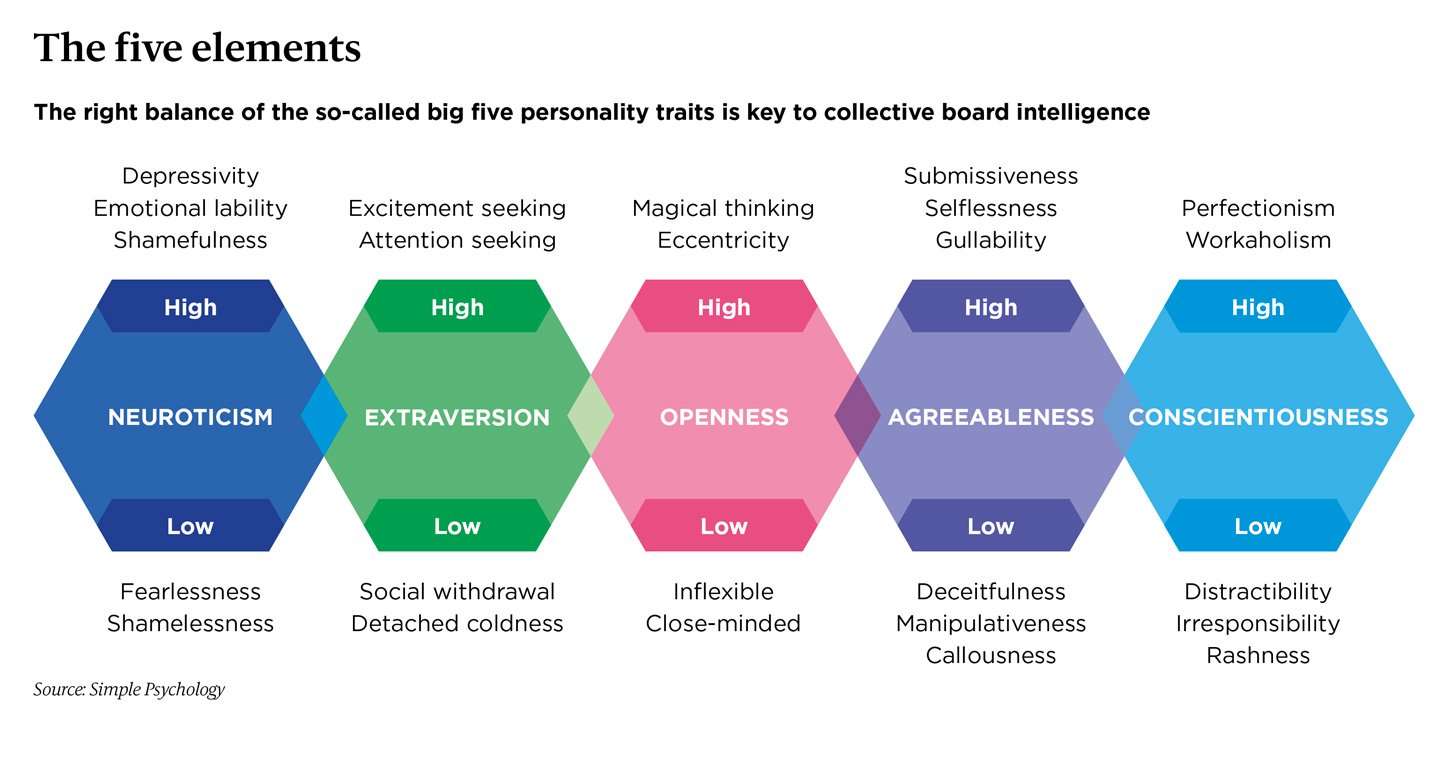
‘Agreeableness’ is one of the ‘big five’ personality traits identified in modern psychology (see graphic). From a personality perspective, Peterson’s research has found that the more ‘agreeableness’ in the room, the more effectively the board functions. “You want people who are inclined to collaborate,” he explains. “You can get away with not collaborating in management, but not on a board.” Pantelides adds that hubris (“when people are so elevated – and have an inflated sense of the quality of their judgement and decision-making – that others don’t feel they can challenge them”) can destroy collective intelligence.
Managing those dynamics falls squarely on the chair, who must also be aware that certain personality traits tend to clash, potentially derailing board meetings. For example, says Peterson, those with high openness to experience can clash with those with lower openness. High-openness types – those who love ideas – and more data-orientated low-openness board members often frustrate each other.
When it comes to understanding the different personality dynamics at play in the boardroom, Dr Tomas Chamorro-Premuzic, organisational psychologist and chief science officer at executive search firm Russell Reynolds, advocates board members undergoing personality profiling assessments. Such tools help develop not only self-awareness at an individual level, but also give a clearer picture of how the group can function as a team.
“You could see that the board over-indexes on disruption, missing the bread-and-butter aspects of performance, or that it over-indexes on attention to detail, so ends up being more tactical than strategic,” he says. Such tools can provide a psychological map of the board, which should be used to both fill vacancies and work together more effectively, as well as giving insight into what personality ‘derailers’ could throw the board off course.
The aim, Dr Chamorro-Premuzic believes, is to have a board rich in cognitive diversity, meaning that “whatever is discussed, you have different points of view present and can make better decisions, while being aware of blind spots and biases”. But getting a cognitively diverse group to function effectively as a team, unleashing collective intelligence, is not always easy.
Harnessing that cognitive diversity, making sure conflict is constructive rather than destructive, is ultimately the chair’s job, who must create the space and psychological safety for people to share dissenting views. As Stiles puts it: “Collective consciousness lives or dies by the chair’s role.” “The chair has to be like a symphony conductor,” says Chamorro-Premuzic – something that requires as much art and emotional intelligence as science.
The often-unspoken hierarchies that exist in most groups mean that status matters even in a room of powerful people. To encourage people to speak up, Peterson encourages directors to actively give ideas a lifeline. “People care about their status, how they are seen by others and don’t want to say anything silly,” he says. “The willingness to say, ‘I’m not sure but it’s interesting,’ sounds simple but it’s a huge thing for boards.”
In a similar vein, Pantelides advocates carefully thinking about how boardroom discussions are shaped, including sharing notes on the board pack in advance. “The best boards think carefully about how to use their time, and about how they challenge their biases and assumptions, and get everyone in the room to share their voice,” she says. “There’s a lot of intentionality around how you get the board to work.”
Advances in technology mean directors can dive into the data: transcription tools can give insight into how much each person spoke, or how decisions were reached, for example. Feedback from board-effectiveness reviews provides further datapoints.
Stiles says boards should consider taking time – in addition to regular meetings – to scenario-plan or undergo crisis-simulation exercises. Doing so creates opportunities to challenge assumptions by throwing boards into a different context. It also helps deepen relationships.
While aiming for collective intelligence, boards must be cognisant of one key risk: drifting into groupthink. This can translate into collective stupidity, as Kodak’s board found to its cost. The key is finding a sweet spot on the continuum that runs from constructive dissent to collective intelligence to groupthink. “You need a bit of tension, which will only come if people are free to speak up – but if you cannot move, there is no harmony,” says Chamorro-Premuzic.
Ultimately, the board needs to be thought of like any team, through the lens of team distribution, performance and effectiveness. That takes work, but it’s worth it. As Pantelides says: “If you pool your collective intelligence effectively, the outcome should be a more agile, informed, value-adding board.” And, in a troubled, complex world, who wouldn’t want that?
About the author

Katie Jacobs is a business journalist specialising in management and the world of work. She has edited business magazines including HR and written for the Financial Times, the Times and Management Today. She is a senior research fellow of The Conference Board. In her public speaking work, she has interviewed everyone from comedians Katherine Ryan and Sue Perkins to FTSE100 chief executives and chairs. When not exploring big ideas with leaders, she can be found wrangling her two young children – who are usually much less interested in what she has to say.

Director Magazine
This article is published as part of IoD Director, the authoritative voice of UK business leadership.

Get updates from Director
There has been an unexpected error.
Thank you for subscribing.
Unsubscribe at any time. Read our privacy policy.


