

Director Weekly The rush to adopt AI poses significant risks to the economy and wider society unless people are put squarely at the centre of its design and deployment
The recent Institute for the Future of Work conference, ‘Making the Future Work’, was an opportunity to underline the importance of putting people at the heart of business’s approach to AI.
The conference, which partnered with the IoD and kicked off with a keynote from Sir Patrick Vallance, Minister of State for Science, Innovation, Research and Nuclear, offered a superb day of discussion on the state of AI adoption and its impact on jobs and work.
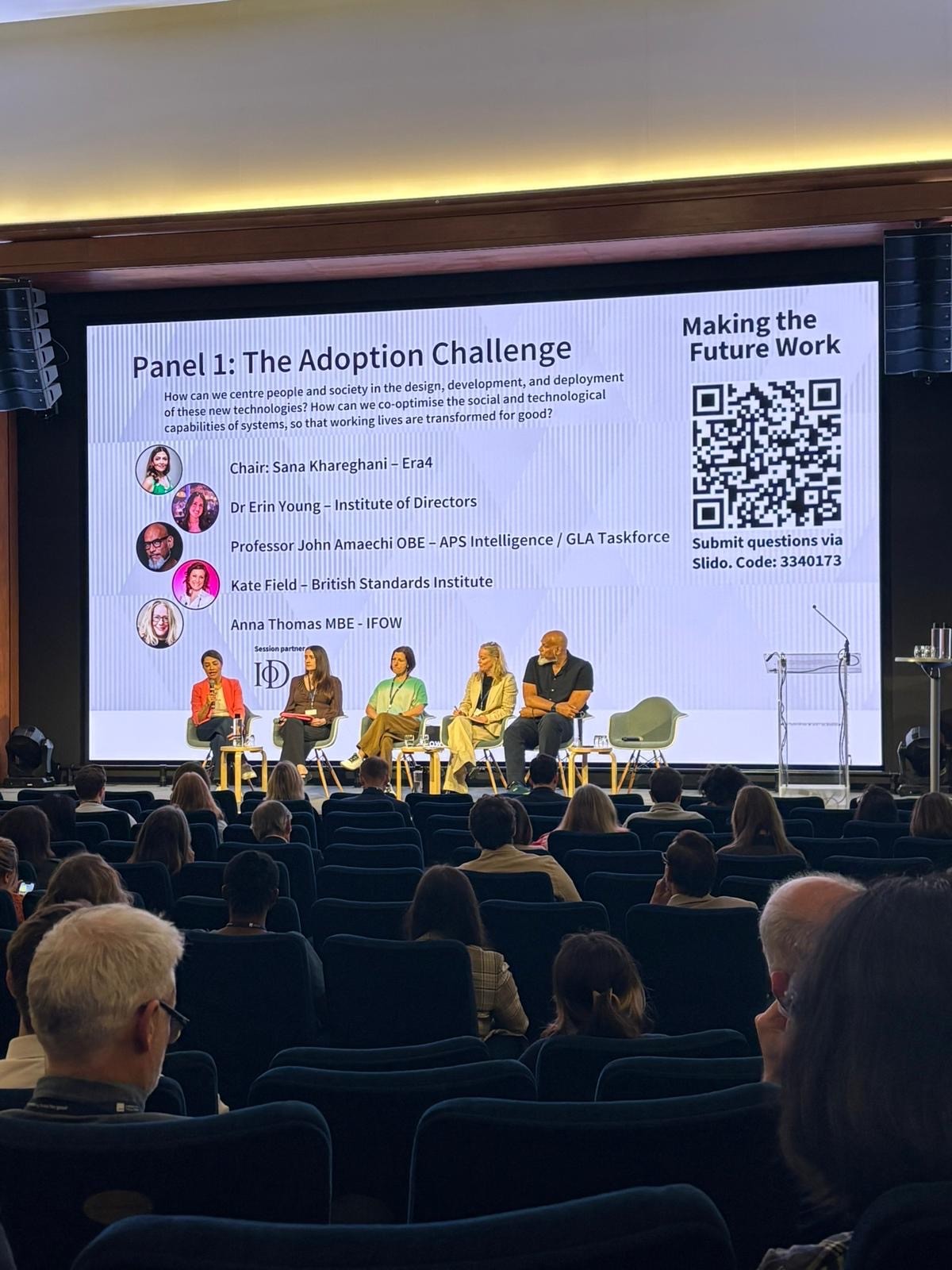
Here are three key points from my panel contribution on ‘The AI Adoption Challenge’.
1. We need to address organisations’ readiness to adopt and govern AI responsibly
The government wants the UK to adopt AI at the fastest rate of any G7 economy. It’s a bold aim, underpinned by a suite of ambitions set out in the AI Opportunities Action Plan.
Yet in its haste to promote AI, the government risks overlooking the need for vital scaffolding that will support good and equitable outcomes. Across the IoD’s membership, we’re seeing a great deal of uncertainty about what responsible adoption looks like in practice. Over a third of directors are unsure which AI skills are, or may become, necessary in their sector, for example.
There are also concerns around the limited understanding of AI at management and board level. Many directors feel they’re being asked to make choices on AI strategies without clarity about guardrails, accountability, or even what ‘good practice’ looks like. Governance standards are critical.
The government is beginning to recognise the challenge. Initiatives such as the AI Skills Boost programme – for which the IoD is a strategic partner – are welcome. But it is early days. More work is needed to address these issues, as well as business leaders’ concerns including around reliability, data, workforce impact, and cyber security (as discussed in another recent IoD article). In particular smaller businesses have real concerns about shouldering the legal, reputational and financial risks.
While heavy-handed regulation that creates greater burdens for mainstream business is not the optimal path forward at this stage, firms do need greater clarity and support. Softer governance mechanisms, such as standards, assurance frameworks, guidance and voluntary codes of practice, have an important role to play.
2. There’s a mismatch between government ambition and the reality of adoption on-the-ground, as well as misalignment between policy areas
The UK’s AI ambitions run far ahead of the operational realities facing most businesses at the moment, particularly SMEs and firms outside the tech sector, which make up the majority of the UK economy.
So far, much of the investment allocated under the AI Opportunities Action Plan has gone into infrastructure and ecosystem-building, such as the AI Growth Zones. Those are important, but many businesses question how they help them adopt AI tools, technologies and systems in their day-to-day operations. In this way, national AI conversations can feel disconnected from the realities businesses are dealing with on the ground.
There are also significant disconnects between different areas of government policy, such as technology, energy and labour market. Policy can seem to push in different directions, when a better-aligned approach to tech-enabled growth could help businesses engage with AI at a time when they’re confronted by rising costs, growing uncertainty and geopolitical instability.
AI could ultimately help some businesses bring down costs or grow; but the most pressing question facing directors often isn’t “How do we adopt AI?”, nor even “What problems are we trying to solve?”. It’s simply “How do we stay afloat?”. More coherent support for business is required to escape that bind.
3. To move beyond polarised debate, people-centred approaches will be critical
Mainstream discussions about AI tend to be highly polarised. Some Big Tech firms offer a utopian narrative of productivity gains and economic growth; others, including many workers, veer towards a dystopian vision shaped by fear of job losses.
For now, there’s little evidence that AI is the cause of the UK’s rising unemployment. Government policies have significantly raised the cost of employment, and we’re now in the midst of an energy price shock.
But binary distinctions aren’t helpful. Many directors have reservations about AI’s downsides while still recognising the potential benefits. They want to get beyond the hype and implement AI technologies in responsible ways.
Ultimately, if we want people-centred AI adoption, we need to spend less time talking about AI in the abstract, and more time focusing on governance and organisational readiness.
About the author

Dr. Erin Young leads the IoD’s policy, strategy and thought leadership work on technology, science and innovation.
Before joining the IoD, Erin was Project Co-Lead and Research Fellow in Public Policy at The Alan Turing Institute, the UK’s National Institute for Data Science and AI, where her work influenced the UK’s National AI Strategy and AI Opportunities Action Plan. Previously, Erin held positions at the United Nations (UN IIEP-UNESCO) in Paris, Kantar/WPP in London, MediaX at Stanford University, and Thomson Reuters in New York City, across policy, strategic communications, research, stakeholder engagement and government affairs.
Erin sits on the Strategy Steering Board for the City of London Corporation’s Women Pivoting to Digital Taskforce, the Advisory Board for the APPG on Entrepreneurship, and advises the Hg Foundation on AI, skills and inequalities. She is frequently featured in high-profile media and presents across business and government including the European Parliament, GCHQ, KKR and the UK Science and Technology Network (FCDO/DSIT) at British Embassies and Consulates globally.
Erin holds a BA in Classics from the University of Cambridge, an MSc (Distinction) in Education (Learning and Technology) from the University of Oxford, a PGC in International Business Practice, Finance and Organisational Behaviour from St Mary’s University, and a Ph.D. (D.Phil) in Science and Technology Studies (STS) from the University of Oxford.

Director Magazine
This article is published as part of IoD Director, the authoritative voice of UK business leadership.

Get updates from Director
There has been an unexpected error.
Thank you for subscribing.
Unsubscribe at any time. Read our privacy policy.


