

Aye, robot Your new colleagues might be more firmware than flesh
The black rhino. The Yangtze finless porpoise. The Sumatran orangutan. Those are some of the planet’s most endangered species, according to the World Wide Fund for Nature (WWF). Perhaps, before long, we might have to add the human board director to the list as well.
Okay, that might be a bit over the top. But anyone who read ‘Can AI boards outperform human ones?’ on Harvard Business Review’s website could be forgiven for wondering about the professional life expectancy of the average board member.
As I floated in my previous column (Director, Spring 2026), the article revealed the findings of a fascinating experiment that had been carried out on both sides of the Atlantic. Academics at the Corporate Governance Centre at Insead in France and the Mack Institute for Innovation Management at the Wharton School, University of Pennsylvania, led the research into the performance of parallel boards set up to analyse and debate the same business issue. Six boards were made up of real-life human executives, and one more board was composed of AI chatbots.
Directors – analogue and digital – were given the same agendas. A two-hour meeting was held, with a transcript taken. After the meetings, the human boards completed a self-assessment exercise. But the work and outputs of all the boards, human and AI alike, were also assessed by independent (human) experts and by AI assessors too. Their performance was measured under eight headings: decision quality; ‘implementability’; collective learning; director participation; use of facts; fair and inclusive process; depth of exploration; and chair performance.
The outperforming bots
The results surprised many. The AI board consistently outperformed the human ones in almost every way.
Readers of my column will recall that, on ‘decision quality’, for example, both sets of assessors said that humans “hesitated and circled around options without landing on a clear strategy”.
Dive a little deeper, and the criticism kept coming: the humans’ discussions were described as “difficult to follow” and “not always well-articulated”. The AI board, by contrast, “reached clear, actionable resolutions”. One assessor said the bot board “framed decisions with explicit contingencies and next steps”.
On “decision implementability”, the expert assessors said that the human boards “rarely translated strategy into concrete targets” and offered “not enough debate based on facts”. But the bot board “aligned its direction with available resources”, and “translated headline choices into concrete actions”. These decisions were “practical, realistic and well-aligned with constraints”.
On facts and data, humans displayed “limited engagement with the pre-read” and “missed opportunities to ground arguments in data”. But AI boards “actively cited figures from the documents”, “reconciled discrepancies in real time”, and “wove quantitative evidence into their reasoning”.
You get the point. Poor, distracted, vain humans simply did not measure up when compared with the cool, rational, unemotional and data-driven discussion and decision-making of the robots.
In search of greater detail (and, frankly, a bit of human sympathy), Director spoke to the two lead academics on this project, Insead’s Stanislav Shekshnia and Wharton’s Valery Yakubovich.
Is the game up for us humans? What will boards of the future look like?
The good news is that both lead researchers take a measured and pragmatic view of how human boards can best deploy, and work with, the powerful new technology.
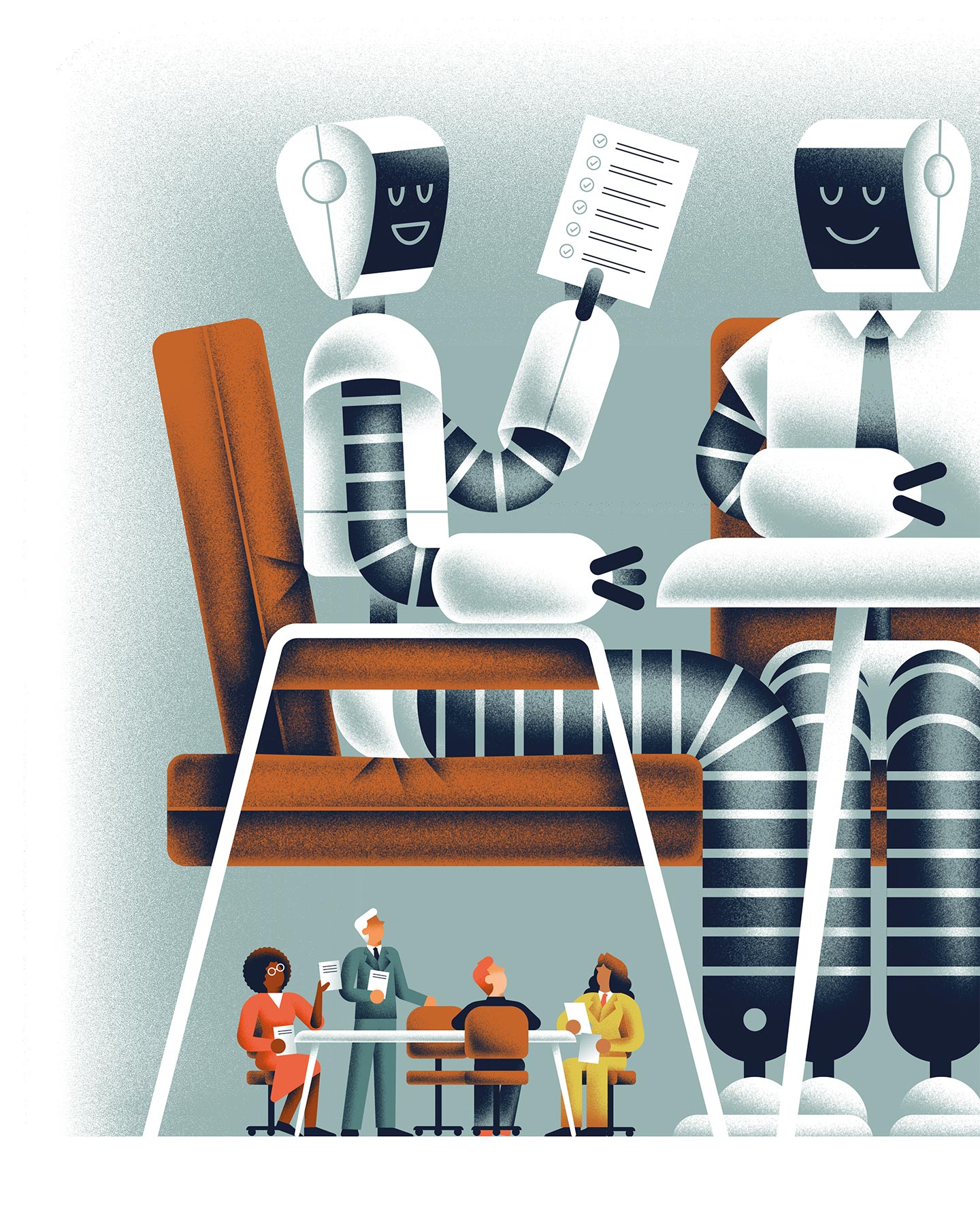
Digital colleagues
Shekshnia suggested there are four ways in which AI could actually help the human board to do better. The first of these has to do with the classic information gap between the board and management – often referred to as ‘information asymmetry’. Directors receive sometimes unwieldy packs of information prior to board meetings, which they may or may not have the time (or inclination) to study properly. But AI can read, digest and summarise such information very effectively, and present it in a more readable form.
Another way AI can help is as a ‘copilot’, a tool to enable more vigorous alternative scenario planning. What if management is proposing only one alternative option? Could AI help you to calculate a few more? Shekshnia says, “For years, board members have been saying, ‘Okay, we need to use scenario planning, but we don’t have the time or the capability to do this…’ And now AI is there to help them.”
A third and potentially more intrusive option is to use AI as a kind of coach to the board discussion, an observer and commentator which can – when invited – intervene to let you know where the discussion is going, and potentially where it is going wrong. The chair could be supported by an AI voice which might say, for example, colleague X or Y has spoken for too long, and colleague Z has not had a chance to speak at all. Or the copilot might say: you have all wandered off from the question in hand. Or: colleague A made a perceptive comment a few minutes ago and it got lost… and so on.
Perhaps the most ambitious and elaborate option is to set up an AI agent as a (quasi) board member and participant itself. It can have a human voice. It can ask to intervene at any time.
Exponential mistakes
At Wharton, Yakubovich reminds us that, while the rapid technological leaps made by AI are impressive, it still has flaws of which we must be aware. “For now, I don’t see when we’ll ever be sure that AI is going to act without major or obvious mistakes,” he says. Yes, there are potentially huge productivity gains to be made. “But as soon as one mistake is made, it escalates, also exponentially. So where to put people in the loop so they catch that?”
This is perhaps the good news for board members, and even for managers at all levels. “This is where a lot of work – future work – will emerge for humans,” Yakubovich adds. “To be in the right places, at the right time, in the loop… everyone becomes a manager, only you either manage agents, or you manage people and agents.”
At board level, new chairing and interpersonal (and inter-AI) skills will be needed, he says: “The board meeting will change, and in the future the meeting may have a mixture of inputs, perhaps with agents speaking up at certain moments…We are now revising all our workflows based on these new AI capabilities. We should do the same with boards.”
For a reality check on the future of boards and AI, it was time to hear from Megan Pantelides, senior director at consultancy Board Intelligence. She warns that a lot of boards – especially at larger companies – are not ready to commit fully to AI in the boardroom, in part because of controls around information security risk. “It’s the risk of people not using AI safely,” she says. “I think organisations are definitely moving at very different speeds when it comes to this.”
One concern has to do with the ‘discoverability’ of board-level discussions, she adds. If AI technology is recording every utterance made in the boardroom, this could have consequences if investors, or others, were to pursue legal action against directors. There is a reason why wise company secretaries do not necessarily record every comment in the minutes.
There needs to be a practical benefit to introducing AI. “We’ve been challenging ourselves to think very carefully about what problem you’re trying to solve with AI, and making sure that we don’t just default to the ‘make it more efficient’ answer,” Pantelides says, “because that is not necessarily going to help boards to operate more effectively… it does not make the board discussion more impactful.”
Legally, human directors are still in the driving seat. “They are still the ones responsible for exercising independent judgement,” Pantelides says. So the questions boards must ask themselves are: what are the decisions that need to remain human-led, and which are the ones that can be delegated to AI? What kind of transparency do we need to have around the role AI is playing in these decisions and in these processes?
The human edge
There is life in human beings yet. We need the humility to recognise the sheer processing power of the new technology. But the best technologists also recognise the limits (and potential hazards) of their inventions.
This was perhaps one of the less well-publicised elements in the original Wharton/Insead research. The board assessors noticed that the AI had struggled with the “informal, interpersonal and cultural aspects of governance”. The bots “excelled in structure and detail” but “fell short in the relational dynamics that shape human interaction”.
If we are all staring at screens, or listening to the computer’s voice, we will be neither looking at nor listening to each other. The duties of a director include turning up and being fully present as a human, drawing on experience and judgement.
Just as the pocket calculator helped us to do our sums quicker, AI will enhance and turbocharge decision-making. But, when it comes to decisions, it is the board who will have to sign on the dotted line, with a real, human signature.
About the author

If you want to read some comforting thoughts about the AI-driven future maybe try a sycophantic large language model (LLM). For some slightly harderedged and realistic analysis read Stefan Stern’s feature on the future of critical thinking. Financial Times and Guardian columnist Stern is quite the fan of human critical-thinking. “I hope it catches on,” he says. His latest book is Fair or Foul: The Lady Macbeth Guide to Ambition – which he swears he wrote all by himself without using AI.

Director Magazine
This article is published as part of IoD Director, the authoritative voice of UK business leadership.

Get updates from Director
There has been an unexpected error.
Thank you for subscribing.
Unsubscribe at any time. Read our privacy policy.


