
IoD press release Director confidence still at near records lows – before and after the Budget
The IoD Directors’ Economic Confidence Index, which measures business leader optimism in prospects for the UK economy, remained at a near record low of -73 in November in the run-up to the Budget – unchanged from October. In our snap poll directly after the Budget, the index rose one point to -72.
Business leader confidence in their own organisations dropped to -5 in November, down from 0 in October. Immediately following the Budget, this dropped further to -20, the second lowest monthly reading on record, after -22 in April 2020 during the pandemic.
In the run-up to the Budget, the underlying indicators saw marginal decline:
- Revenue expectations inched down to +7, from +13 in October 2025.
- Headcount expectations declined to -8, from -2.
- Investment intentions to -17, from -13.
- Cost expectations rose to +86, from +81.
- Export expectations dropped to +6, from +8.
Following the Budget, some underlying indicators shifted downwards significantly:
- Revenue expectations fell to -8 (post-Budget), from +7 (pre-Budget) – the lowest since September 2020.
- Headcount expectations fell to -29, from -8. This is the indicator’s third lowest reading.
- Investment intentions fell to -39, from -17. This is the second lowest reading of this indicator, after May 2020 (-43).
- Export expectations fell to -2, from +6. This is the second lowest reading of this indicator, after July 2025 (-4)
- Cost expectations declined slightly to +82, from +86.
Of the factors having a negative impact on businesses (asked quarterly):
- UK economic conditions (77%) remain the most significant concern, little changed from 76% in August 2025.
- Employment taxes (60%) and business taxes (50%) continue to be of significant concern.
- Levels of concern about compliance with government regulation (37%) and the cost of energy (36%) ticked up from last quarter (32% and 30% respectively).
Of the global risks that are most concerning for business leaders (asked quarterly):
- Global economic slowdown remained the biggest perceived risk at 59% in November 2025, from 60% in August 2025.
- Concerns about cybersecurity increased significantly, to 58% in November 2025 up from 44% in August 2025.
Anna Leach, Chief Economist at the Institute of Directors, said:
“Because this Budget landed midway through our fieldwork, we were able to track business leader confidence both immediately before and after the announcements. In the weeks running up to the Budget, persistent speculation over tax rises kept confidence subdued. And with our snap poll showing that four in five business leaders (80%) view the Budget negatively, it is no surprise that confidence remains close to record lows afterwards.
“More worrying is the further deterioration in the underlying economic expectations. Headcount and investment expectations have fallen sharply, to levels close to those seen during the pandemic. Revenue expectations have also eased, though they are holding up better than other indicators. Crucially, confidence in leaders’ own organisations has dropped too — a sign that the Budget has weakened sentiment not just about the UK economy, but about firms’ ability to grow in it.
“The message from this Budget is that work remains to be done to lift the UK’s growth prospects. The biggest opportunities remain in planning reform, a serious programme of deregulation and public sector efficiency. But the immediate outlook for business investment and employment has weakened further, and that will require further attention. The decision to only introduce unfair dismissal rights for employees after six months is a very welcome and pragmatic compromise, balancing confidence in hiring with worker protections. This should help give employers confidence that they can correct hiring mistakes without risking lengthy and expensive tribunal cases. We look forward to working with the government to ensure that the Employment Rights Bill strikes the right balance for both businesses and employees.”
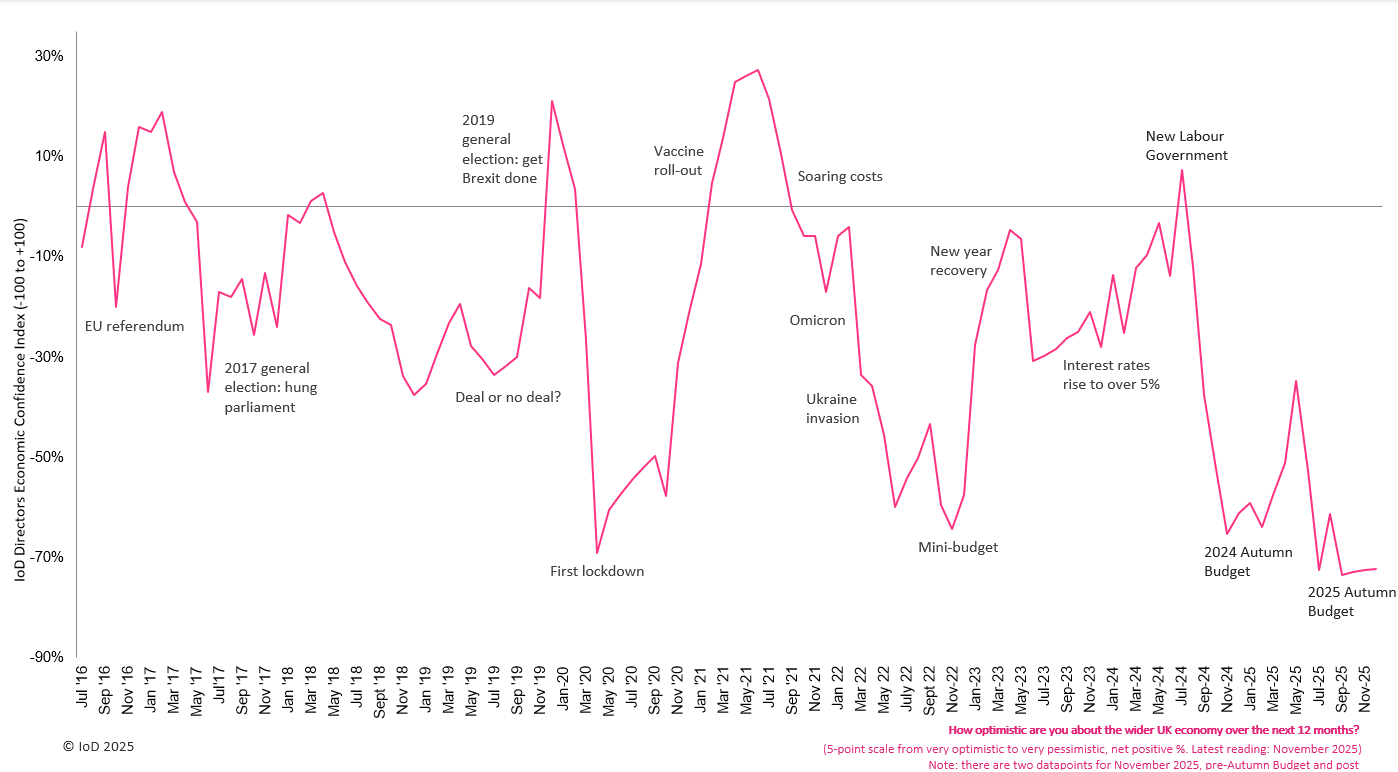
The IoD Directors’ Economic Confidence Index measures the net % positive answers from members of the Institute of Directors to the question ‘How optimistic are you about the wider UK economy over the next 12 months?’ on a five-point scale from ‘very optimistic’ to ‘very pessimistic’.
Full Results
680 responses from across the UK, conducted between 14-26 November 2025. 13% ran large businesses (250+ people), 21% medium (50-249), 23% small (10-49 people), 30% micro (2-9 people) and 13% sole trader and self-employed business entities (0-1 people).
How optimistic are you about both the wider UK economy and also your organisation over the next 12 months?
Comparing the next 12 months with the last 12 months, what do you believe the outlook for your organisation will be in terms of:
Which of the following, if any, are having a negative impact on your organisation?
Which of the following global risks are the most concerning for your business in 2025? Please choose up to three
Post-Budget polling results
507 responses from across the UK, which went live immediately after the Budget announcement, and remained in the field for 24 hours.
How optimistic are you about both the wider UK economy and also your organisation over the next 12 months?
Comparing the next 12 months with the last 12 months, what do you believe the outlook for your organisation will be in terms of:


