

Where have all the young people gone? Your firm needs an ageing strategy
Last May, Ivor Ward made headlines in his local Leicestershire newspaper – and the national press. The newspapers described how he enjoyed his four-day-a-week factory job, partying at the weekend with colleagues, and how he was looking forward to travelling in two years to celebrate a significant birthday.
What made Ward’s story newsworthy was his age. Born in 1926, the former poker pro and Royal Engineer had just celebrated his 98th birthday. He had retired briefly when he was 79 – but soon became bored. He started his new job aged 80. Ward’s story illustrates a corporate issue of growing importance – how should firms respond to an ageing population?
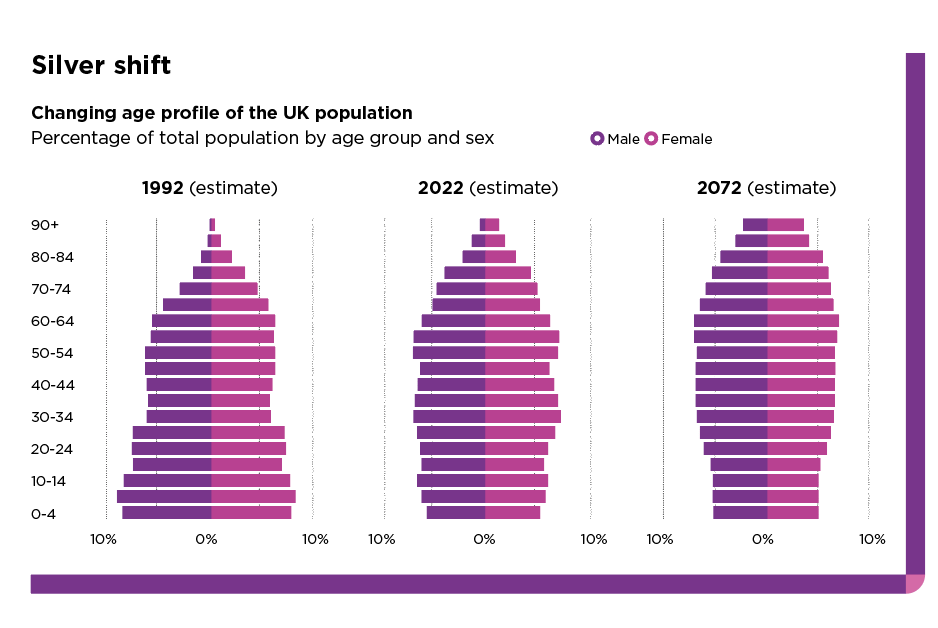
Both in the UK and globally, birth rates are falling, and people are living longer. The result is fewer younger people and larger older cohorts, collectively termed an ‘ageing society’. Back in 1965, when I was born, the average British woman gave birth to approximately three children over her lifetime. Today, that has nearly halved. Were it not for immigration, the UK population would be declining, as it is in China, Italy and Japan.
While there are fewer young, there are a lot more older people. Since 1965, the number of Britons over 65 has more than doubled to reach 14 million. By 2032, there will be more Britons aged over 65 than under 19. At 98, Ward is in good company, with the fastest-growing demographic being the oldest ages. Back in 1965, there were 13,000 people over 95; today, there are 156,000.
These changes are bringing about dramatic shifts in the composition of the workforce. Longer lives are creating new career paths, which together raise multiple issues for organisations. When two-thirds of employment growth in the UK is accounted for by workers aged over 50, it is an issue firms cannot ignore.
But workforce issues shouldn’t be the only ones on the corporate agenda. Older people are not only the fastest-growing demographic. They also tend to be the wealthiest cohort. If firms don’t have a policy for what that means in terms of products and services, they risk missing out on one of the fastest-growing global emerging markets.
Above all, ageing isn’t just a macro trend but one that will impact you at the most personal level. Mentioning an ageing population invariably leads to a focus on ‘older people’, but that is to miss the most fundamental shift. Previously, only a minority could expect to live into their tenth decade. Now, according to the Office for National Statistics, it is a majority. We may not all live to be as old as Ivor Ward, but we must increasingly prepare for that possibility. This is about all of us, regardless of age.
The three Rs: recruitment, retention, retirement
My book The 100-Year Life – coauthored with Professor Lynda Gratton – outlines the changing career patterns that longer lives demand. The 20th century created a three-stage life of education, work and retirement. As life expectancy increases, we cannot simply stretch out these three stages by only increasing the retirement age. More profound changes are required – and are happening.
Ultimately, longer lives are about having more time. Some of that must be spent working (which is why the state pension age has increased), but not all of it. During the 20th century, the additional time gained was taken in the form of a longer retirement. But with retirement age now rising, more of that time will be taken this side of retirement. For younger adults that involves postponing the start of their careers by taking time off to travel or pursue more education. For older workers, it may take the form of retiring and then ‘unretiring’ – or transitioning into retirement through a move into flexible part-time work or the gig economy.
Careers will become ‘multi-staged’ for other reasons too. At certain times of life, financial issues will dominate, and long working hours will be acceptable. At other times, raising a family or caring for older relatives will be most pressing, requiring flexible working. Others faced with a longer time until retirement may find themselves bored with their job and seek new challenges. Some may be forced into finding them – because their job is too physically demanding, or technology has taken away their role.
With fewer younger adults, firms will have to look at multiple ages when they recruit. That requires avoiding ageist thinking in hiring and ageist language in adverts, identifying new talent pools and non-traditional ways of both finding and onboarding them. Retention will also become more important as younger workers become scarcer. With an ageing workforce, many firms are unaware of just how much firm-level knowledge and experience is about to walk out the door if it is not retained. Age audits to see which areas and skills are at risk are crucial.
Offering structured processes that enable employees to ramp up and ramp down their time commitments will be important, especially given that an ageing population comes with a growing caring need for older parents. Currently, one in five employees are family carers, and a significant number resign each year, unable to juggle the demands of work and family effectively. Providing flexibility and support to manage those pressures will be a distinct recruitment advantage and support productivity.
To help with retention, firms must also focus on designing ‘age-friendly jobs’ that are flexible, provide greater autonomy, are less physical, and help keep older workers in place for longer. This is also helped by the greater use of robotics and simple changes to the workplace, such as slowing down the production line, providing chairs, etc. Creating age-friendly jobs for older workers not only helps keep them working longer but also frees up positions for younger workers to move into.
Retirement is already undergoing major change. It is no longer a binary outcome characterised by a switch from full-time work to no work. It takes on many guises – from full to part-time work, a change of role, a break followed by unretirement or a portfolio career. For some, like Ward, retirement just isn’t an option. As a result, there is great diversity in what people want to do. For those in good health and in a role they enjoy, continuing to work is great. For others, it’s a financial necessity or something to be avoided at all costs. The result is that it is very hard to infer from someone’s chronological age what they need and what they want. Uniform policies based on age don’t work for people in their 20s or 40s. Nor do they work for people in their 60s and 70s.
Problems of ageing
A common objection to adopting an ageing policy is that it doesn’t make commercial sense. But that is to misunderstand the profound demographic changes that are occurring. Unless you can replace all your workers with robots you will have to adapt.
Another objection is to see older people as a problem because they aren’t very productive, have higher pay and aren’t so innovative or adaptable. Not only is there surprisingly little evidence to support these widespread claims, but to assume they are true is to put yourself at an immediate disadvantage. Writing off the fastest-growing part of the workforce is not a smart commercial strategy. It is also likely to lead to multiple legal suits given that ‘age’ is a protected characteristic and covered by discrimination legislation.
But are older people less productive? That is a question that has launched a thousand research papers without any firm conclusions. The results vary enormously across occupations, sectors and individuals. In some occupations, experience is incredibly valuable; in others, physical strength and endurance are at a premium. What is true is that the changing nature of jobs over time has helped older workers maintain their productivity. Education – rather than age – is the more important driver. That points to the importance of ensuring that learning and development is focused on all ages and not just the young.
Another common objection is that keeping older people in work creates unemployment among the young. That is simply untrue. Yet there is a related problem around blocking career progression for younger workers. That is a potential issue for innovation, if the German physicist Max Planck is right that ‘science advances, one funeral at a time’. To avoid this challenge, firms must move away from hierarchical structures and build intergenerational teams exploiting age diversity.
Younger people may be better at innovation but – crucially – not all new ideas are good ideas. The most effective innovation comes from mixing teams of different ages and experience. In hierarchical settings, that is unlikely to happen, but creating space for interaction, sharing and learning will be key. That also requires change from older workers. Longer careers demand an element of reinvention, of being open-minded to change and learning, as well as perhaps that most difficult task of all – unlearning.
The evergreen economy
Focusing on the workforce implications of demographic change is only part of the story. There is also a lucrative consumer shift that is occurring, often referred to as the ‘silver economy’. Whether it be reunion tours of 1970s rock bands, or cruise ships and luxury retirement apartments, this is a market that is already taking shape. Understanding the needs and desires of older consumers will become increasingly important. That may be another reason for valuing older workers, as they are less likely to fall into the trap of assuming the only things older people want are incontinence pads or sensory alarms to monitor falls.
In my book The Longevity Imperative, I argue that something more profound is happening. We are now likely to live a long life, but we fear getting old. That makes ageing well a key imperative, and it is something best started before you are old. When you have only a 10% chance of living to 90, it doesn’t make sense in your 30s or 50s to invest in your 90-year-old self. It does when you have a more than a 50% chance.
Ensuring we live a life that isn’t just longer, but also healthy, productive and engaged for longer is a market worth trillions of dollars. It is relevant for all ages and across all countries. This ‘evergreen’ economy impacts every sector – the food and beverage market, leisure and education, real estate and finance. It will also demand that the health sector goes beyond just doctors and hospitals to cover multiple aspects of our daily lives. Few markets are as valuable or as important.
Business is the distribution arm of social change, both through the nature of work and the products it delivers. Adapting and adjusting to longer lives and a shifting age distribution is an enormous corporate opportunity. It is also one of the most important personal issues you will deal with. That is why Ivor Ward made the headlines. He speaks to all our futures. Are you ready?
About the author

Professor Andrew Scott is a director of economics at Ellison Institute of Technology and professor of economics at London Business School. He is the author of ‘The Longevity Imperative’ and ‘The 100-Year Life’, both runners-up in the Financial Times & Schroders Business Book of the Year awards. He is a firm believer that the secret to aging is using old photos.

Director Magazine
This article is published as part of IoD Director, the authoritative voice of UK business leadership.

Get updates from Director
There has been an unexpected error.
Thank you for subscribing.
Unsubscribe at any time. Read our privacy policy.


