

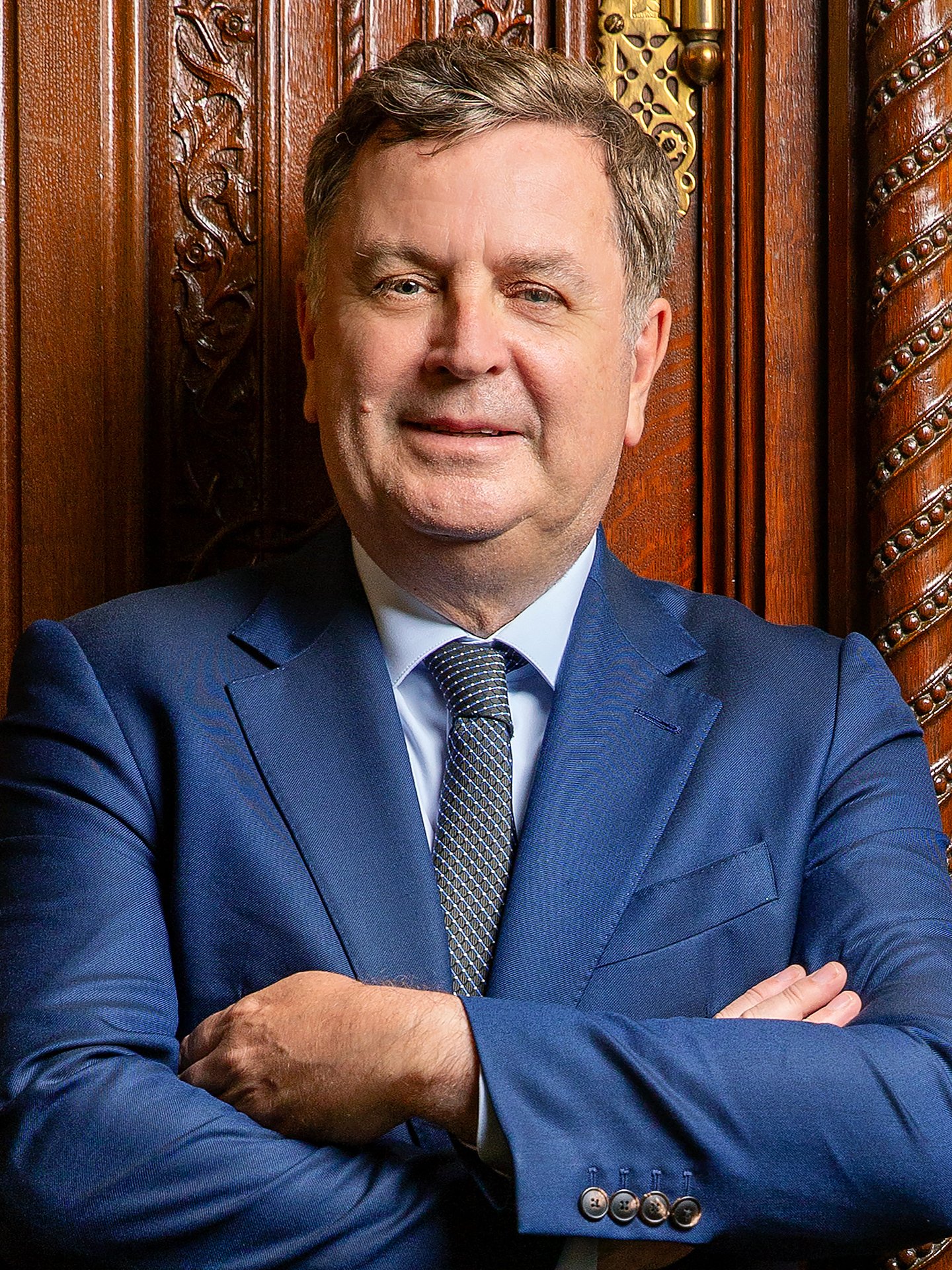
Tour of duty Shadow chancellor Sir Mel Stride seeks responsible radicalism
Sir Mel Stride rises early. Very early. While others schlep to the coffee wagon, wait for their flat white and croissant, Sir Mel makes a splash. “I swim,” he says. “I wild swim when I can.”
Stride learned long ago that dawn starts bring dividends. By 25, he was troubled that so few graduates were entering industry – preferring the bright lights of the City or the professions. He surmised that industry had fashioned neither the right image nor achieved a sufficient profile to attract them – and hatched a plan to help.
This fan of bracing dips made cold calls, hammering the phones of industrialists until someone picked up. The strategy eventually bore fruit – the hour was too early for their personal assistants to be in the office to screen Stride’s calls. “I figured if I phoned early, the secretary – the gatekeeper – wouldn’t be in,” he told The Rest is Money podcast. One day, the then Shell chairman Sir Peter Holmes picked up the phone. The young Stride told him about his idea to launch an exhibition to attract talented youngsters into industry – and a fascinated Sir Peter invited him to share his thoughts over lunch. Shell backed him, and soon other major firms signed up. His exhibition idea became a reality.
Honest history
Stride’s inquisitive nature has led him down several paths. He has been a tour guide, regaling visitors with the storied histories of the British Museum, the Tower of London and Westminster Abbey. A favourite pastime is genning up: “I like sitting in the corner of a room, in a nice, comfy chair, reading something,” he tells Director. “I find that kind of relaxing… but I suppose a lot of it is political.”
These extracurricular hobbies might offer a temporary diversion from the gravity of the challenge ahead. “We’re at a debt level approaching 100% of GDP,” he says. “We’ve got ourselves into a position through this government that the servicing cost of that debt is about £100 billion a year, more than twice what we spend on defence. We’ve got an ageing population, greater demands on health, pensions. We’ve got a welfare bill that’s spiralling ever upwards. There needs to be an honest conversation with the public about the fact that we are not living within our means, and therefore there will need to be some tough choices around getting on top of
that debt.”
The fiscal challenge is not one that will be solved by tinkering, he argues. He is an advocate of what he calls “responsible radicalism”– the conviction that only a fundamental shift in the way the economy is run will deliver the growth and productivity enhancement Britain needs to escape the vortex. “How do you go from this anaemic growth to ticking along at the levels that you need?” he asks. “You need to get out of a kind of managerial, incrementalist mindset and into a truly radical mindset – that is still responsible. So, I coined that expression – ‘responsible radicalism’.”
He is starkly honest that such responsibility was lacking in a Tory Party that, for several years, had become intoxicated by a malign cocktail of populism and profligacy. “The responsibility bit is that you have to do it with the numbers adding up,” says Stride. “You can’t slash taxes left, right and centre just to try and generate growth without explaining where the money is coming from – which is what we saw in the back end of 2022.”
It remains rare to hear a senior politician criticise their own party. Yet honest appraisal is the father of renewal. “You cannot have tens of billions of pounds worth of unfunded tax cuts sent into a fairly inflationary environment and tight labour markets, and expect to have anything other than an adverse bond market reaction and all the things that followed from that,” he says. He has been consistent, he adds, whether analysing from the stage or the stalls. “When I was chair of the Treasury Select Committee at the time of the Mini Budget, I said before it happened, when it happened, and after it happened, that this was a big mistake,” he says. “I was something of a lone voice in certain quarters. We will never, ever as a party, do that ever again. We have to regain that sense of trust with the electorate on the economy.”
It is that responsibility that will set his party apart, he says, from its rivals on the right of British politics – a Reform Party that has surged in the opinion polls to lead both the Tories and Labour. “There’s a very clear reason for that, which is also an explanation as to why I don’t think it will persist,” says Stride. “They’re doing well because you’ve got a Labour Party that is doing badly. You’ve got a Conservative Party that got eviscerated at the election. And then you’ve got a vacuum in the middle. The None Of The Above Party, who have no track record to criticise, can run around saying, ‘We will take everybody earning up to £20,000 out of income tax altogether.’ That will cost £80 billion or upwards – about half what we spend on the National Health Service – which has one and a half million employees. When they are asked where they will get it from it’s, ‘Well, there’s lots of waste everywhere, isn’t there?’ I’m sorry, but that’s just not good enough. That positioning will become more difficult. Our mission is to gain fiscal responsibility, get a hearing, get some trust, be an effective opposition… building a serious, sensible plan while Reform carry on with this populist plate-spinning – this glittery firework display – which they’ve got to keep up for four years.”
Volatile future
Stride’s fusion of realism and responsibility offers a foundation for a rebuild. If a week is a long time in politics, four years is an eternity. “Nobody can predict the future,” he says. “That’s the only thing you can say with certainty: it’s highly volatile. It could be any one of up to five parties that could win the next election.”
Does he still expect his main opponent at the next election to be Labour? “I don’t know,” he says. “If this were 2019 and I was the Labour shadow chancellor, you’d be saying to me, ‘Mel, Labour Party, biggest defeat since the 1930s. You’re going to be out of power for a generation, aren’t you? How on earth are you going to come back?’ And yet, look what happened just five short years later.”
He looks across the Atlantic to Canada, where the cast-iron favourite Conservatives lost to a Liberal Party led by former Bank of England governor Mark Carney. “[Then Conservative leader] Pierre Poilievre was a shoo-in, wasn’t he? Twenty-three points ahead! He didn’t just lose the election – he lost his own seat. That’s the world we’re in now. Populists thrive on that kind of froth. But it’s down to us to try and triangulate that sense of being serious and the grown-ups in the room. The fiscal responsibility. But – equally – cutting through and getting our vision out there.”
Stride’s Responsibility Test is just one part of that vision. He is sensibly inscrutable on specific fiscal policies so far out from a general election, but he offers prisms through which those policies will be defined. He proposes a Growth Test as his second criteria. “We have to get the tax burden down,” he says. “We have to ask a fundamental question of each tax to what degree does it lean into growth, wealth creation, job creation and so on.“That goes into simplification of tax too,” he adds. “There are many anomalies within the tax landscape where you get very high marginal tax rates, typically around the interplay of benefits.”
The prohibitive marginal income rates imposed on parents who are on the cusp of £100,000 in annual earnings is a clear example: “If you have three children, across that tapering, you are facing [up to] 76% tax,” he notes.
Stride has recently returned from a trip to the United States, where he met Dr Arthur Laffer, he of the eponymous curve, familiar to economics students the world over. Laffer believes that the UK’s tax landscape has reached the apex of his curve; that further tax rises will reduce the tax yield because they act as a powerful disincentive to enterprise. “You certainly want to be looking for those taxes which are on that point on the Laffer Curve where actually you could reduce the rate and increase the yield,” Stride says.
Stride will apply his three tests – the Responsibility Test, the Growth Test and the Laffer Test – as he crafts his policies ahead of facing the electorate in 2029. Yet there is a role for chancellors beyond fiscal policy – by championing enterprise, making entrepreneurialism attractive, inspiring the young into starting businesses. Stride suggests that the talk can be almost as important as the walk. “I look back to my story,” he says. “I started in 1986 – and that was when the Conservatives were beginning to cut taxes and removing red tape. But they also did something else. The zeitgeist then was very different to what it is now. It was summed up by that photograph of Margaret Thatcher and Richard Branson on the boat going up the Thames. Sun playing on the water. The dream of opportunity. It was cool to set up businesses. And that’s what we’ve got to get back to.”
Inclusive capitalism
Stride advocates what he calls “inclusive capitalism” – part of which is the dream of a share-owning democracy where stock ownership is incentivised, and equities are common gossip in the Dog & Duck. “But some of it is about the mood music and talking about it as a government,” says Stride, “encouraging people to get out there and showing them that you’re going to give a bit of assistance on the way. We want to celebrate those people.”
Inclusive capitalism might be the dream. Exclusive capitalism is the reality. Stride worries that an ever-increasing number are excluded from enterprise, employment and economic contribution by a state that has an unsophisticated, binary approach to workability. People can either work or cannot; are either fit or sick. “There’s 400,000 people leaving the workforce every year who go on this journey and end up on benefits,” he says. “And at some point along the way, they go to their doctor, and their doctor signs them off sick. And in 94% of occasions – after a six-minute interaction – ticks a box that says, ‘Couldn’t possibly work under any circumstances.’”
Stride envisages a more proactive state, where welfare focuses on keeping people in work rather than signing them off it. “If you can’t cope with the stairs, we’ll talk to your employer,” he says. “We’ll get your desk down on the ground floor. We’ll even sort a taxi. We’re going to keep you in work – that’s the important thing.”
The march of technology, too, will undermine the promise of an inclusive economy – if we let it. Stride takes aim at the higher education sector which, he argues, continues to offer courses that are unfit for a transforming world. “You may have been studying coding at Oxford one minute,” he says, “thinking that you’re set up for the rest of your life, and suddenly finding you’re entirely redundant, because AI will do all that much better than you ever will.”
How interventionist is he willing to be? Does he envisage a state that tells universities which courses to supply? “Could you design a system in which the university themselves is incentivised to make sure that they’re providing courses that lead to well-remunerated employment?” he asks. I point out that he is answering my question with a question. “I am, yes,” he says. “Because we are doing the work to come to the answer. I don’t have all the answers yet.”
He might find some. His background is varied, his experiences wide. I wonder whether this inquisitive knight of the realm, wild swimmer, exhibition impresario, tour guide, businessman, is ever frustrated by the constraints of Westminster. “Most people, say, ‘We want people in parliament that have done something,’” he says. “I had done something. I built companies. And I thought that was something that I could bring to political life.”
Has he ever regretted it? “No, not at all,” he says. “That’s not the same thing as saying there haven’t been times when it’s been frustrating and difficult. But it’s the most wonderful privilege. And I wouldn’t have missed it for the world.”
About the author

Ben Walker is editor of Director magazine.

Director Magazine
This article is published as part of IoD Director, the authoritative voice of UK business leadership.

Get updates from Director
There has been an unexpected error.
Thank you for subscribing.
Unsubscribe at any time. Read our privacy policy.


