

Green light The Green Party’s deputy leader Rachel Millward is serious about business
The Seven Sisters are, according to author Bill Bryson, “one of the great walks of England”. The Sisters, a series of white cliffs, are the cover stars of his The Road to Little Dribbling. The book is a love letter to the British landscape with a serious message: that the countryside is an asset unmatched anywhere in the world, yet the British fail to appreciate what they have. Too little has been done to protect the economic and community assets – farms, post offices, village shops and pubs – that allow it to function.
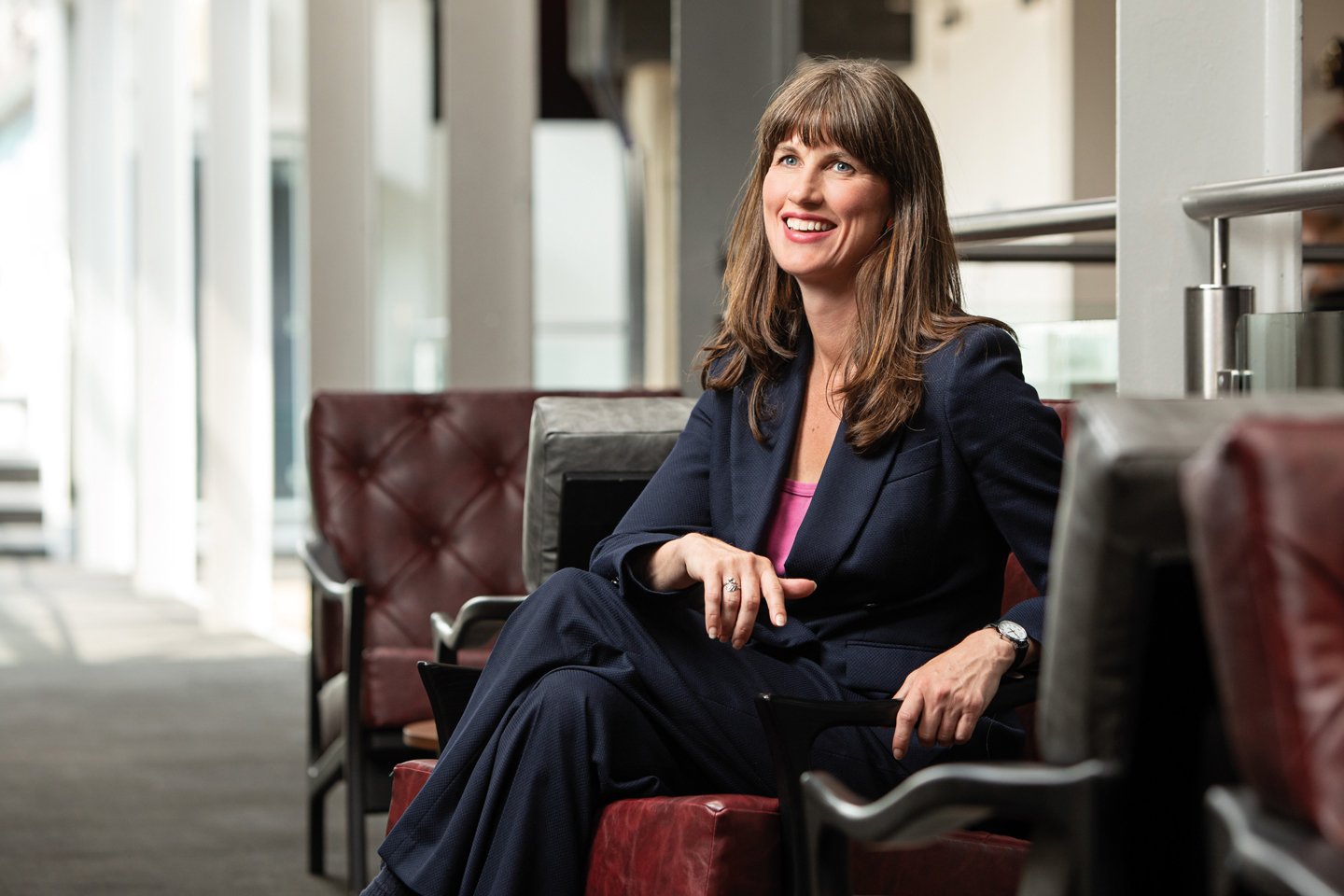
Green Party deputy leader Rachel Millward wants to be mayor of the Seven Sisters, and more. In 2028, she will run for one of England’s newest mayoralties – Sussex and Brighton. The ancient county of Sussex and its sometimes salubrious, sometimes seedy, seaside metropolis will be united again in a mayoralty that stretches 75 miles along the coast and up into the meadowed hills of the South Downs.
It is a territory blessed with natural beauty. Yet, like Bryson, Millward is emphatic that the countryside must have a raison d’être and be a liveable working place where businesses can thrive. Most of all, she argues, the resources of rural England must be able to access – and be attractive to – the youth labour and dynamism more often associated with cities.
“The big parts of the job are housing, transport; planning important infrastructure with a strong commitment to people and nature thriving together,” she says. “The planning system is fundamentally profit-based, and so landowners and developers do fantastically well out of it – but these algorithm-based targets don’t mean you actually meet the needs of an area.”
Millward knows of what she speaks. She is leader of Wealden District Council, a rural rump that covers much of East Sussex. “I know from grappling with our local plan… it could be really exciting for basic provision,” she says. “Transport could be absolutely transformed around the rural parts of Wealden. But it’s almost nonexistent. I can’t overstate how bad it is… there are literally no buses.”
The lack of infrastructure means travelling a few miles – between villages; from the rural hinterland to Brighton for jobs; or the other direction to opportunities in farming or rural business – can be difficult for many. “Connectivity and affordability are so important because isolation is such a problem already,” she says. “There is a lot of joining the dots to be done, because there are these amazing centres of education and skills training, but they are not necessarily connected to employment.”
She talks regularly to local farmers, starved of young talent in a county where the population centres are largely inaccessible to agricultural firms: “They all say, ‘We absolutely have to inspire the next generation of farmers somehow to help us feed the country here.’ We have never really considered the level of food insecurity we’re going to face.”
Is there any cause for optimism? “[Farmers] are feeling pretty bleak about things,” she says. “Let’s be real – loads of government policy works against them as small businesses. The National Insurance hike. The unfairness of the business rates system. These are all things that we’d want to change.”
Currently, metro mayors have only limited fiscal powers – but Millward hopes Prime Minister Andy Burnham’s devolution agenda will change that. “We don’t know where that line of influence will fall yet, do we?” she says. “As the devolution programme develops, we will see what mayors can do. Because, obviously, the more fiscal control you have, the more money you can raise.”
Millward’s transport and economic development ambitions will depend on the revenue-raising measures required to fund them. Her prospective mayoralty has assets ripe for sweating: the pretty inns and hotels scattered across the South Downs; and Brighton – Britain’s dirty-weekend capital. She eyes a so-called ‘bed tax’, a precept added to hotel rooms for overnight visitors that is commonplace in continental Europe.
“As long as we can reinvest it locally!” she says. “We have a lot of enterprise, innovation and some tech. There’s this corridor into Crawley and Brighton from London, which could be exciting for tech and creative industries. But we need to connect the universities into that, create apprentice schemes, join it all together.”
Squeezing added value from the local food industries is crucial too, she says. “We need to look at new routes to market for Sussex food – celebrating it. The more you can support and sustain what is already there, and connect it to different sectors within whatever powers the mayors will have to make local businesses thrive, the more you can make places where people can live and work successfully. You might live in Brighton because it’s this fabulous, progressive, vibrant, creative city that has the sea. For a lot of people in wider Sussex, nature is huge in terms of what they love about the place and why they live there. Whether that’s the Seven Sisters or Ashdown Forest. That works for people as a motivator.”
Millward’s focus on green-tinged economic development seems a far cry from Zack Polanski’s self-declared ‘eco-populism’ that won him the party leadership. I wonder how well that term sits with her. “It was a term that he used strategically at a point where he was saying to the Green Party, ‘If we don’t have a wider appeal, we might as well pack up,’” she says. “The perception of us at that point was quite intellectual, very idealist. It was all very inspiring, but not a wide movement. And what he has done brilliantly – certainly with younger people – is make Green politics seem like a potentially mainstream political force.
“I don’t think he’s ever said anything that’s anti-business. I just think it hadn’t been his target audience, which is why his Chambers of Commerce speech was so important.” (He addressed the British Chambers of Commerce in June.)
Will the populist frame endure? “It was probably just about who he was speaking to at the time,” she says. “But I don’t think ‘eco-populism’ is something he’s clinging to.”
Unlike some in her movement, Millward skilfully frames the economy and the environment as an interconnected whole, rather than opposing forces. I suggest that many Director readers would like to see more of her business-friendly style from her party. With refreshing candour, she agrees. “I want to be saying more of this sort of stuff in the Green Party!” she says. “Entrepreneurialism is vital for our vision for the future. Sometimes there is a perception that we’re all hairshirts and no business – and that isn’t a vibrant future economy. What excites me is actually tackling the long-term challenges head-on, the challenges that businesses are facing all the time. So, no head in the sand about climate change. We must understand its impact.”
When we meet, in high summer, London is enjoying a brief respite from what seems like a near-permanent heatwave. Much of England has toiled through sometimes extreme temperatures, making working difficult or, in some sectors, impossible. “If we needed a wake-up call, well, this summer we’re having it,” says Millward. “Productivity is obviously so down. The impact that it’s had is huge. I sat in a two-hour briefing from the Met Office about where the forecast of 2056 was going. My word! 45°C peaks will not be fun.”
Again, she is effective in linking environmental factors with economic outcomes. That rising temperature causes declining output; that heatwaves are bad for business. “It is absolutely dramatic,” she says. “We all know it, don’t we? Because you can barely think. We need maximum workplace temperatures, which means we need to be investing in workspaces so they can keep cooler. That doesn’t mean we want everyone to be sent home. It means we want to work ahead to prevent that. It is smart business. If you’re looking at your risk register, the impact of climate change should be right at the top and flashing red, because it’s dramatic and it’s happening very quickly. We must collectively make sure that it doesn’t spiral out of control any more than it’s already going to.”
Investment in cooler streets lined with trees, and clean lakes and rivers to allow for public swimming, will have a direct positive impact on productivity, she says: “It all ties together. There is a dramatic difference between what it looks like in 20 years with us carrying on as we are, and what it looks like if we do everything we can to reverse the trend.”
If Millward’s business focus surprises, perhaps it shouldn’t. “I’m from an entrepreneurial family,” she says. Indeed, the 49-year-old is the daughter of one of Britain’s most successful entrepreneurs – the late pioneering market researcher Maurice Millward of Millward Brown fame. Rachel was the first wealthy child in her family; her older siblings were from her mother’s previous marriage. “I was really aware of the privilege that I had because it was new to the family,” she says. “My siblings had grown up with a very different situation. Single mum, dependent on benefits, dependent on the welfare state. They were in beds with woolly hats on in the winter, and it was damp and difficult. But I had whatever we needed.”
Her father’s worldview rubbed off on her. “My dad had a very successful business but always clung to his socialist principles,” she says. “He couldn’t have been a bigger proponent of wealth taxation. He felt that the most important thing he was doing was contributing to the economy, and he wanted to do that more. As he got older, he was aghast at how inequality was getting worse.”
The IoD’s commission ‘Business. A Force for Good?’ asks whether commerce is a catalyst for societal improvement. Millward – the cofounder of the Birds Eye View film festival, which promotes women directors and screenwriters – thinks it is. “A lot of people who set up businesses of all kinds are doing it because they kind of want to make society a better place at some level,” she says.
The deal, she argues, is reciprocal. “The B Corp movement proves that often productivity goes up when people feel invested as part of it. Business can be this really positive part of their lives. And the outcomes – the pure money, business, bottom-line outcomes – benefit from that kind of commitment.
“The goal is a wellbeing economy, where people are living well. If you’re loving the work you do – because you’re part of a bigger picture, you believe in the purpose, you’re well respected and you’re paid decently – that is going to make people happier.”
About the author

Ben Walker is editor of Director magazine.

Director Magazine
This article is published as part of IoD Director, the authoritative voice of UK business leadership.

Get updates from Director
There has been an unexpected error.
Thank you for subscribing.
Unsubscribe at any time. Read our privacy policy.


